Who will crack the great mystery of the dodecahedron?
Author: Harry Lindelauf
Photography: Via Belgica
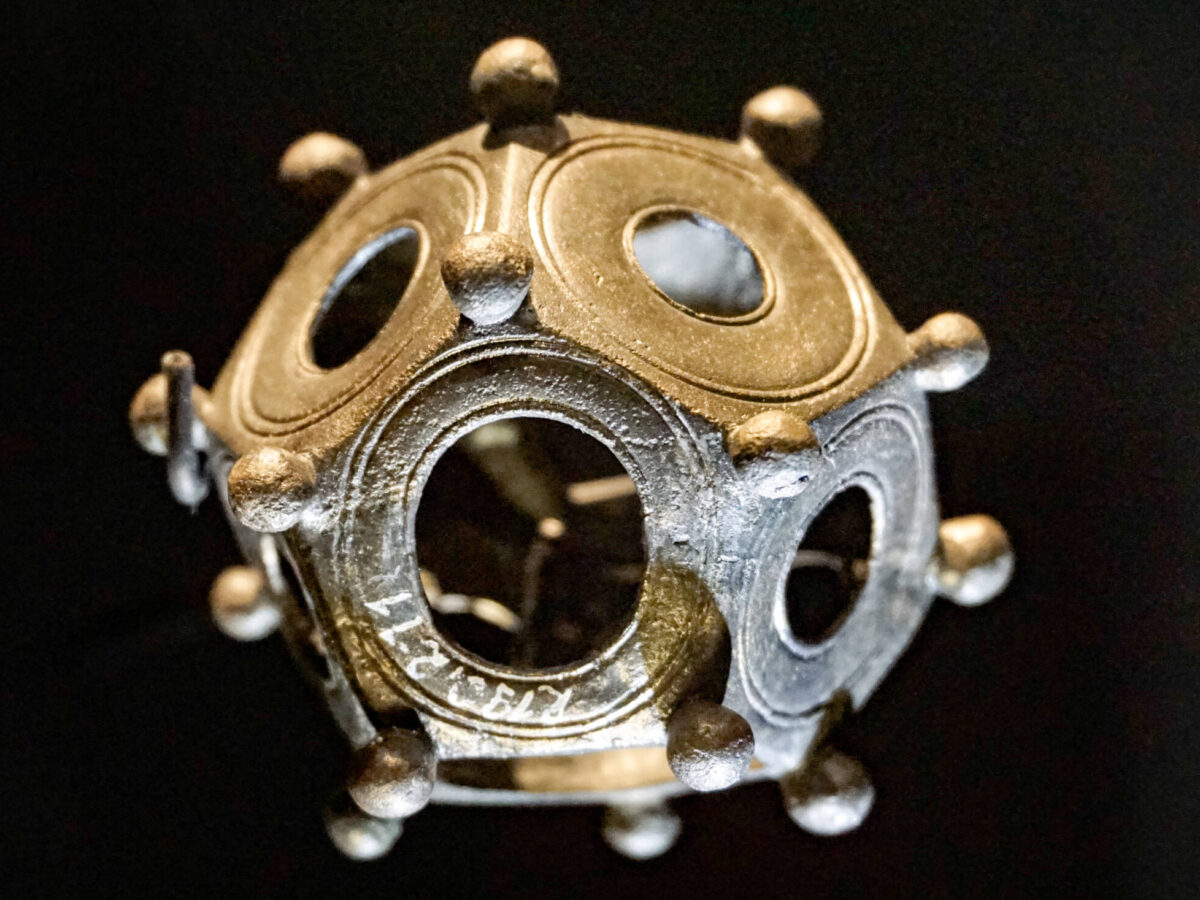
Between Maastricht-Mariënwaard and Rothem, parts of a particularly mysterious object with an equally remarkable name have been found along the Via Belgica. These are pieces of a dodecahedron from Roman times, and no expert has been able to prove what it was used for.
What kind of thing are you bringing up now? Even that gruesome name…
Yes, I understand what you mean. That is because you recognise the word “dode” and give it the Dutch meaning. But the original Greek name refers to the twelve (dodeca) faces (hedron), each face being a pentagon. So you can relax — it is not as gruesome as it sounds.
Good. But tell me, what is it?
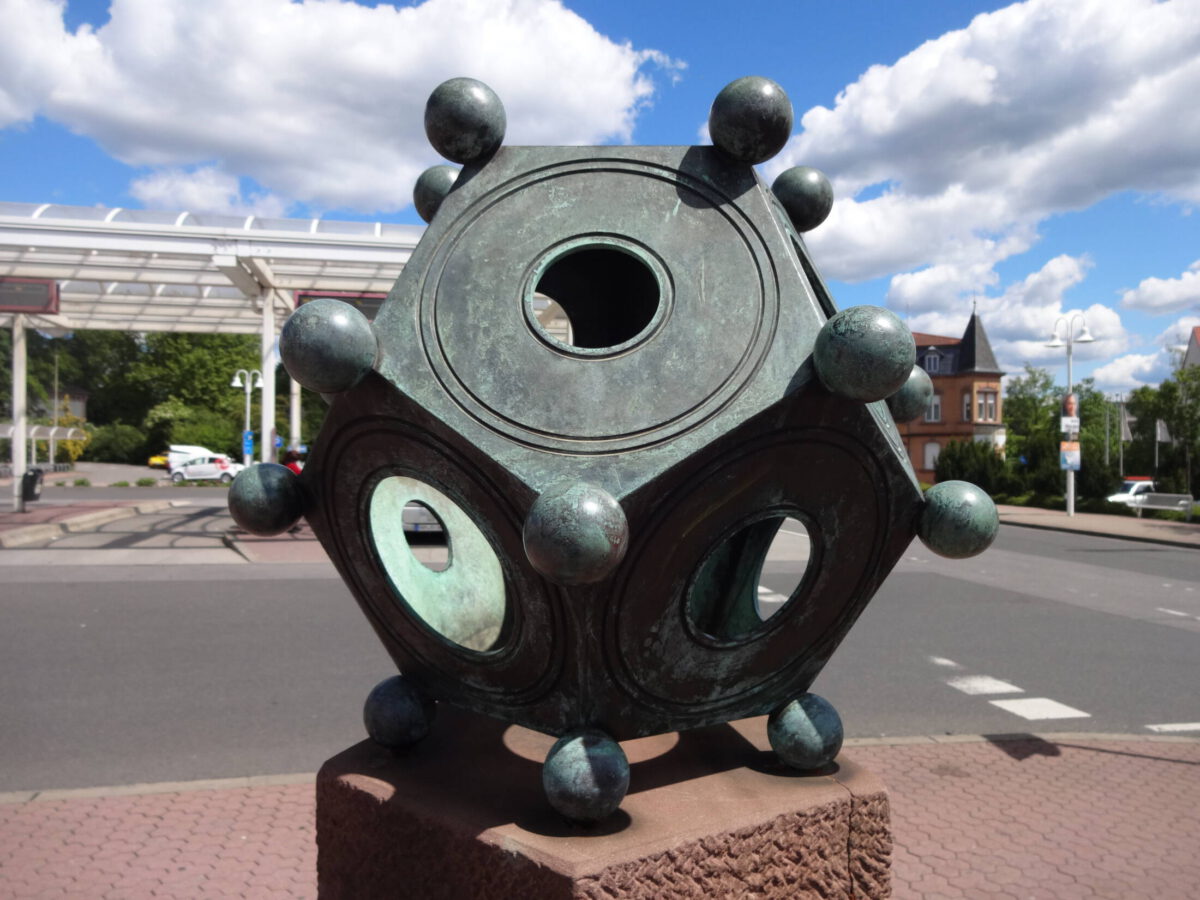
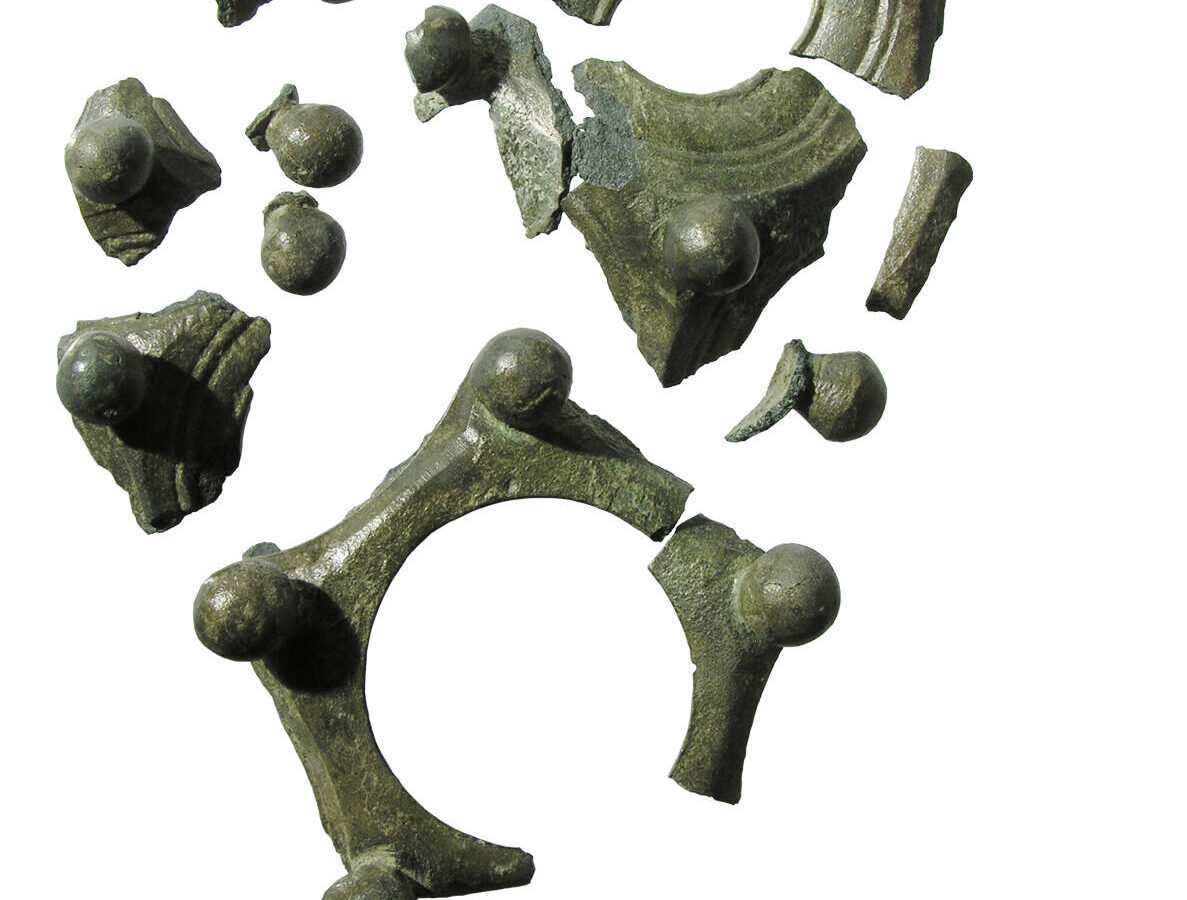
This object was cast in bronze in the second or third century. So far, about 120 specimens have been found, mostly in England, France, Germany, Belgium and Switzerland. In the Netherlands, two have been found: in Elst and in Maastricht near Rothem along the Via Belgica. The Maastricht dodecahedron is not complete; only fragments have been found. Close to home, other finds are known from eastern Tongeren and Bassenge in the province of Liège. Both of these were found in a burial field. Dodecahedrons vary between 4.5 and 8.5 centimetres in size. It is an impressive piece of casting work with openings in all faces. Also remarkable are the little legs with a tiny ball on each corner.
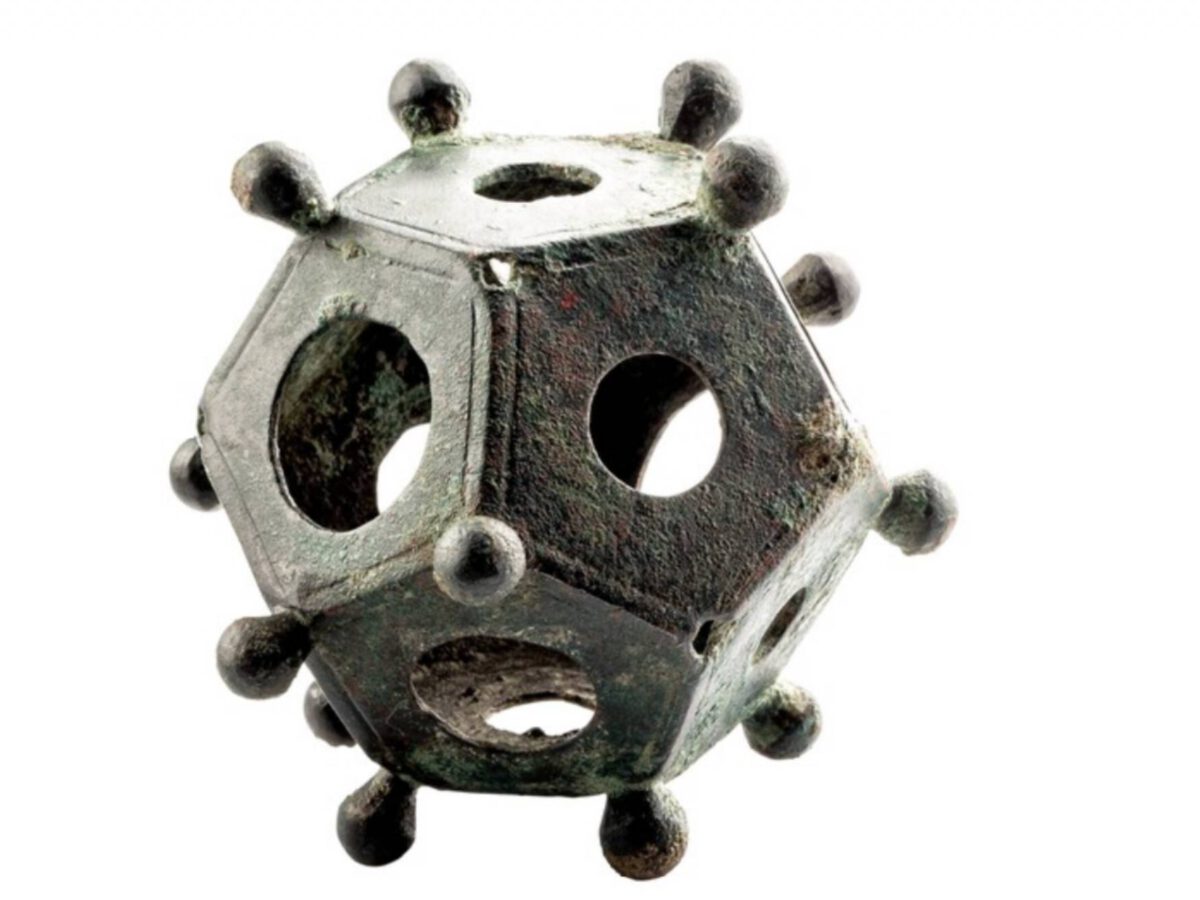
What did the Romans use the dodecahedron for?
The short version of the truth? No idea. They were clearly used for something once, but in recent centuries no one has been able to prove what for. By the way, you simply assume that the Romans used them — but that, too, has not been proven.
How so? They were made in Roman times in regions occupied by the Romans, weren’t they?
Yes, that is true. But the strange thing is that no dodecahedron has ever been found south of the Alps, let’s say in Roman “home territory.”
If it is not a Roman invention, do we know where it does come from?
The ancient Greeks drew this — and other — mathematical shapes. The Romans had knowledgeable generals, capable leaders, architects and builders. But mathematics was apparently not really their thing. The Celts, who lived in Western Europe before the Romans, did have mathematical insight — they used mathematical shapes as symbols. So it is quite possible that the dodecahedron is not as Roman as you think.
You just said that we have “no idea” what this little masterpiece was used for. I find that hard to believe.
I mean that no one has been able to prove a function. That leaves room for a rain shower of ideas and trial balloons. Some scholars have carried out serious research and study, while others come up with suggestions that — let us be polite — are mainly creative.
Give me some examples…
Let me reach into a richly filled grab-bag. It may have been an instrument to:
- check whether coins were the right size,
- calculate the sowing date for grains,
- determine distance to an object,
- knit gloves,
- serve as an ornament on a sceptre,
- function as the end of a club,
- hold candles.
Creative indeed. But I miss a Greek variant — the Greeks were the discoverers of this shape, right?
Very sharp. Come with me back in time. The mathematician Hippasus of Metapontum was, roughly 2,500 years ago, the first to depict the dodecahedron as a shape. His compatriot Plato invented, about 100 years later, that five geometric symbols represented the elements of creation: the tetrahedron for fire, the hexahedron for earth, the octahedron for air, the icosahedron for water, and the dodecahedron for the universe or ether.
That is far removed from a knitting tool or star calculator. What strikes me: so far you only give opinions from others. What do you think?
Oof, now I open the tap of modesty to full. If many bright minds cannot crack this Roman Rubik’s puzzle, who am I to say anything?
That is still not an answer…
Well then, with all modesty: I suspect that we are dealing with an object without a practical purpose. Nothing for measuring or calculating — the sizes of the various specimens differed too much. In line with Plato’s ideas, it could easily have been a symbol used by the Celts and their descendants during rituals at funerals in Roman times. Remarkable is that the dodecahedron is still used as a symbol today, for example among Freemasons. Why do I think of funerals? Because several dodecahedrons have been found in burial grounds, such as in Tongeren and Bassenge. But again: it is nothing more than an amateur’s idea. Whoever can truly crack the mystery may raise their hand — and after that I will deny ever having said anything about the function of that big mystery of that small dodecahedron.