Klettenbergpark in Cologne
Klettenbergpark
In this area, the Roman road traversed the rural outskirts of the Roman city. Numerous farms on both sides of the road ensured the basic needs of the population. The roadbed of the Agrippa Road—like the other long-distance roads in the region—was paved with gravel and bordered on both sides by wide, unpaved sandy tracks. Roadside ditches provided drainage.
Agrippastraße, within what is now Cologne city limits, ran parallel to the Roman aqueduct at an average distance of 200 meters. This 95.4 km long aqueduct supplied the inhabitants of Roman Cologne with 20 million liters of fresh spring water daily from the Eifel region. Today, Berrenrather Straße runs parallel to Luxemburger Straße, directly on the route of the aqueduct. There, in front of house number 436, the core of a pillar stump is still preserved. It once belonged to the series of arches that spanned a valley depression at this point.
Klettenberg Park, with its lake, flower meadow, and rose garden, lies on the site of a former gravel pit and is therefore significantly lower than the adjacent Luxemburger Straße. During the city’s expansion at the beginning of the 20th century, the park was laid out in 1905 as a Rhenish natural garden.
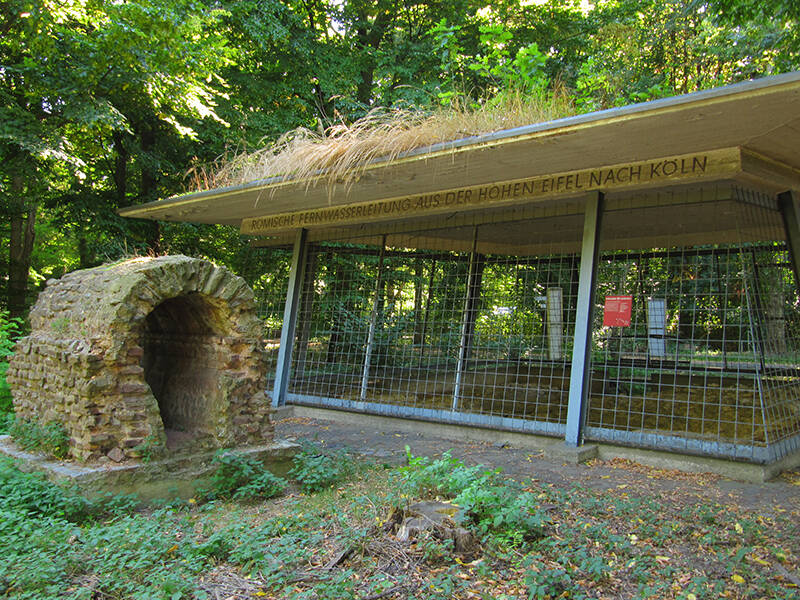
It’s best to stay on Berrenrather Straße, because shortly after crossing the military ring road, you’ll find the so-called “sludge trap” on the left. The Romans had built a settling basin here in the last section of the aqueduct before Cologne, where suspended solids in the water could settle.
Fun to know
- Photo: Website Erlebnisraum Römerstraße