Roman Road Station in Aldenhoven
Roman Road Station
It all began when Emperor Augustus had a revolutionary idea: he established the cursus publicus, the state courier and transport service. The carriages used to transport messages, goods, and people traveled along Roman roads—such as the Via Belgica. At this location stood one of the inns that were situated at intervals of at least 40 kilometers along these roads. These 40 kilometers corresponded to the distance considered a day’s journey in the Roman Empire.
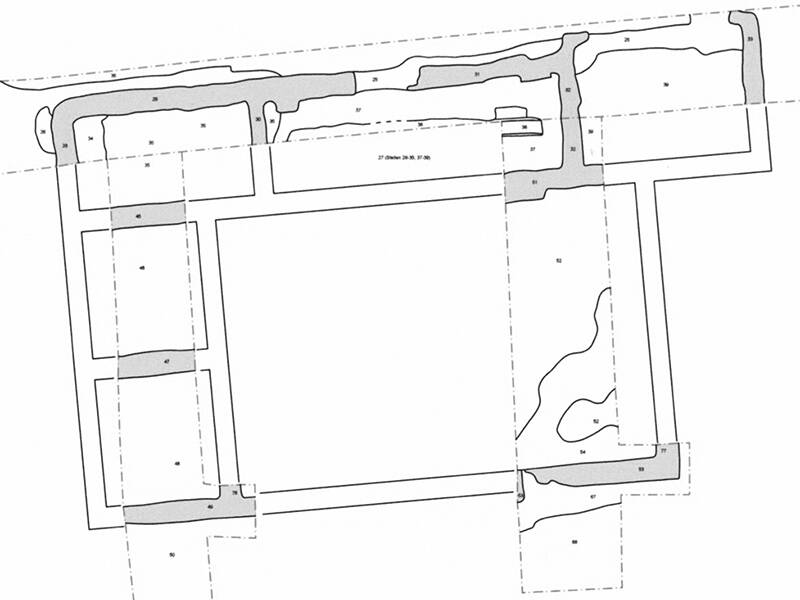
The road station in Aldenhoven was discovered in the 1960s, when Roman bricks and pottery shards were found in a field. A geophysical survey revealed the layout of a rectangular building with a projecting corner room, its main façade facing the Via Belgica. Here and along the western narrow side, the building was divided into roughly equal-sized chambers arranged around a courtyard—a layout characteristic of Roman inns.
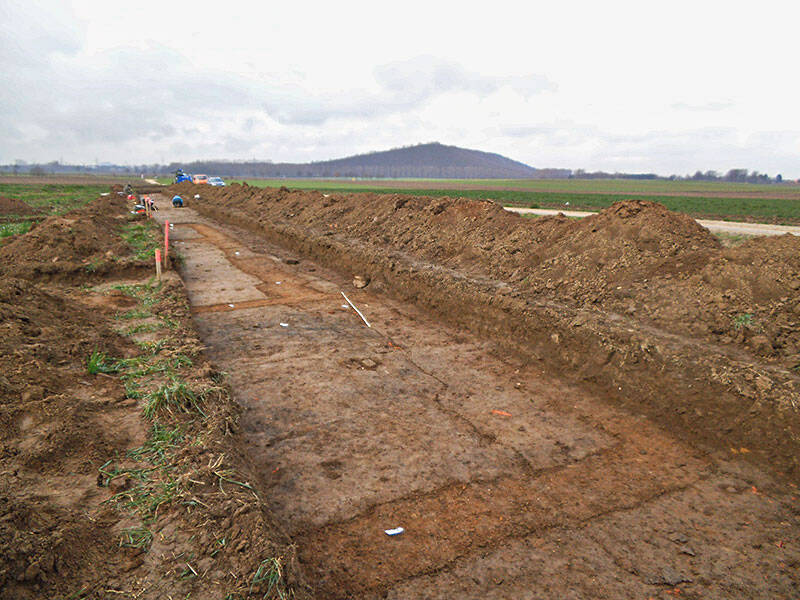
Further surveys showed that, in addition to the main building, there were also auxiliary structures. These typically included a stable and a barn, and often a bathhouse as well. To the west of the building, a side road branched off from the Via Belgica toward the southwest. The ground plan of the inn was confirmed in spring 2014 through an archaeological excavation.
Fun to know
- First photo: Website Erlebnisraum Römerstraße
- Second photo: an aerial photo from 1953 shows a sanctuary along the Via Belgica. Photo: S. Jenter, LVR Bureau for Archaeological Heritage Management in the Rhineland.