The extraordinary “sarcophagus” of Simpelveld
Author: Harry Lindelauf
Photography: Rijksmuseum van Oudheden
These are the favourite Via Belgica finds of the experts. Discover what archaeologists answer to our question: what is your favourite Roman find along the Via Belgica in South Limburg? The answers are varied and surprising. From a bronze Diana leg to spectacular sandstone cinerary chests. In ten episodes we present the choices of the experts. In the eighth episode:
Saskia Stevens— Archaeologist
“The cinerary chest is a find of extraordinary significance: you not only see how people in the second and third century in the south of the Netherlands (then part of the province Germania Inferior) dealt with the dead. You also look into the life of this woman, and that is what I personally find so special. The cinerary chest depicts how this woman, clearly of wealthy origin, lived and shows how strongly Roman culture, as we mainly know it from Italy, had found its way to the edges of the empire.”
Saskia Stevens is enthusiastic about the find of miner Andreas Wierts. As a university lecturer in Ancient History and Classical Culture (Utrecht University), she specialises in the history and archaeology of the Roman Period and is project leader of the research project Constructing the Limes.
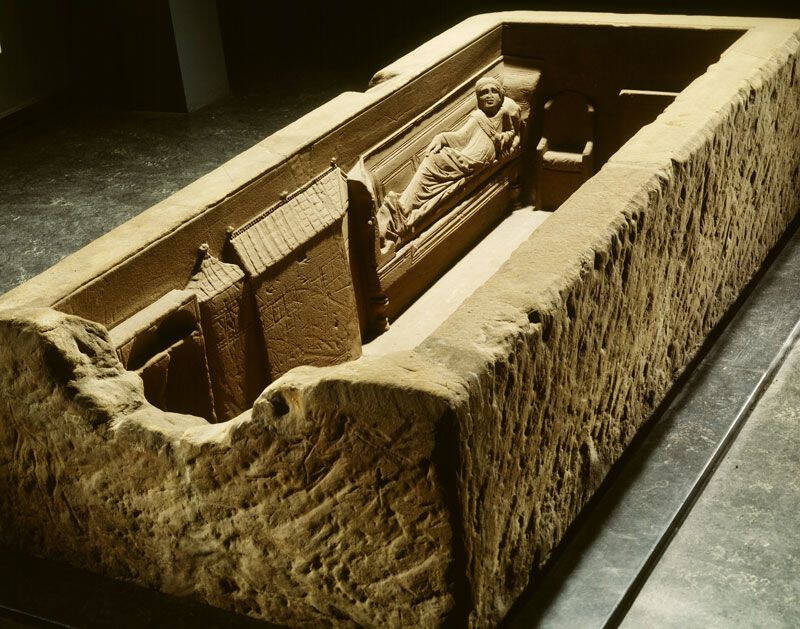
The interior of the “sarcophagus” of Simpelveld.
Spectacular interior
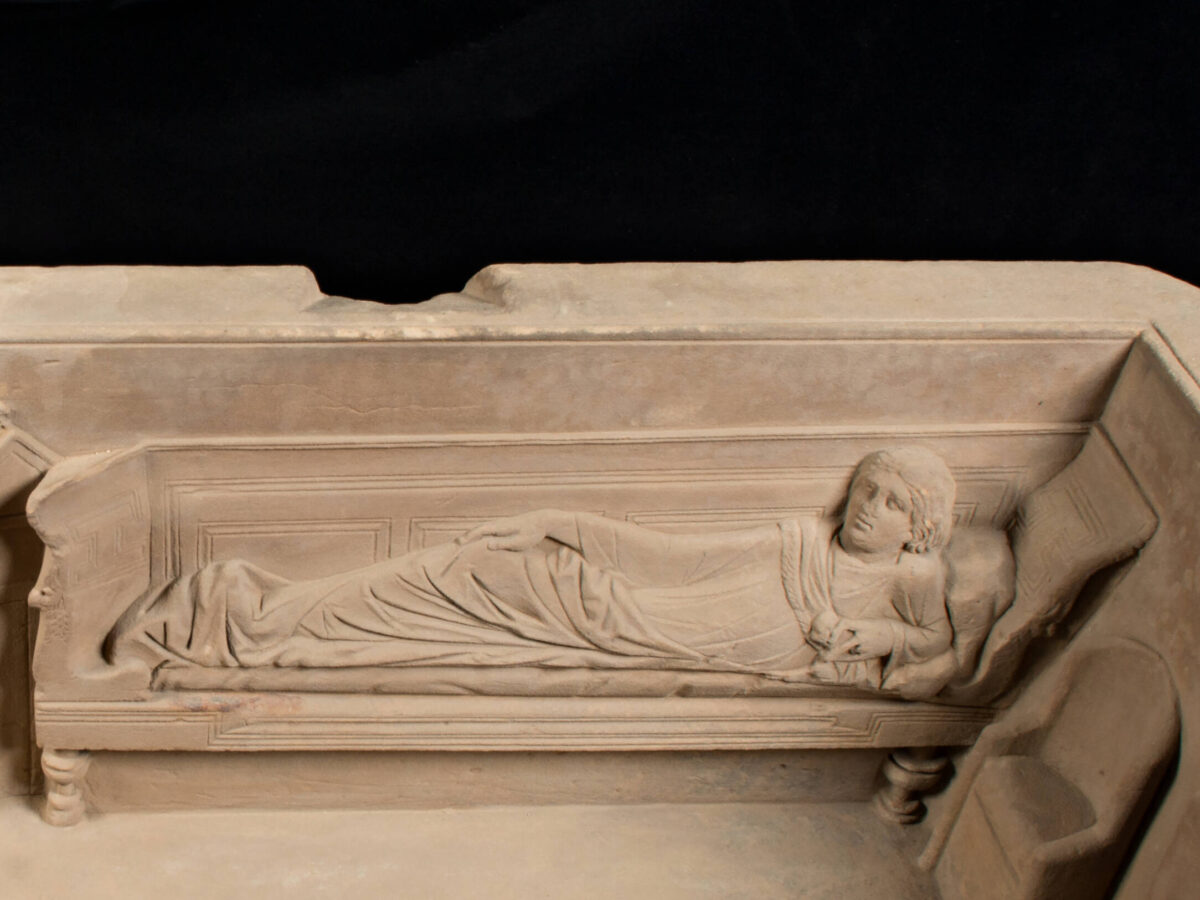
The modern story of the cinerary chest, alias sarcophagus, begins with Andreas Wierts. In 1930 he finds, during the renovation of his house in the Stampstraat in Simpelveld, several Roman graves and urns. In December the super-find follows: a sandstone cinerary chest with a dull exterior but a spectacular interior thanks to images in deep relief on all walls. The sculpture shows a woman lying on a bed, presumably the deceased, surrounded by household items, such as a table with lion’s paws, a cupboard with panelled doors, glass bottles and amphorae, and furthermore a depiction of a building, possibly a dwelling house or a burial tomb.
“Super-find” and “unique in the world”.
Roman villa
Grave robbers have searched the chest through a hole, but several grave goods are still present. Among them gold jewellery, a small glass bottle, a mirror and the cremation remains of the woman. In 1937 a Roman villa is discovered not far from the Stampstraat. It seems logical that the woman in the cinerary chest lived in this villa. A replica of the chest stands in the Thermenmuseum in Heerlen.
The original is in the National Museum of Antiquities in Leiden and was carefully examined, restored and provided with a new base in late 2020 and early 2021.
See also why Tom Buitendorp chooses this find. “Super-find” and “unique in the world”.