How busy was the Via Belgica?
Author: Harry Lindelauf
Photography: Mikko Kriek
How intensively did the Romans use the 27-mile-long section of the Via Belgica between Maastricht and Rimburg? Who was travelling along it, why, and with what? A search for 2000-year-old answers to modern questions.
Was it really that busy?
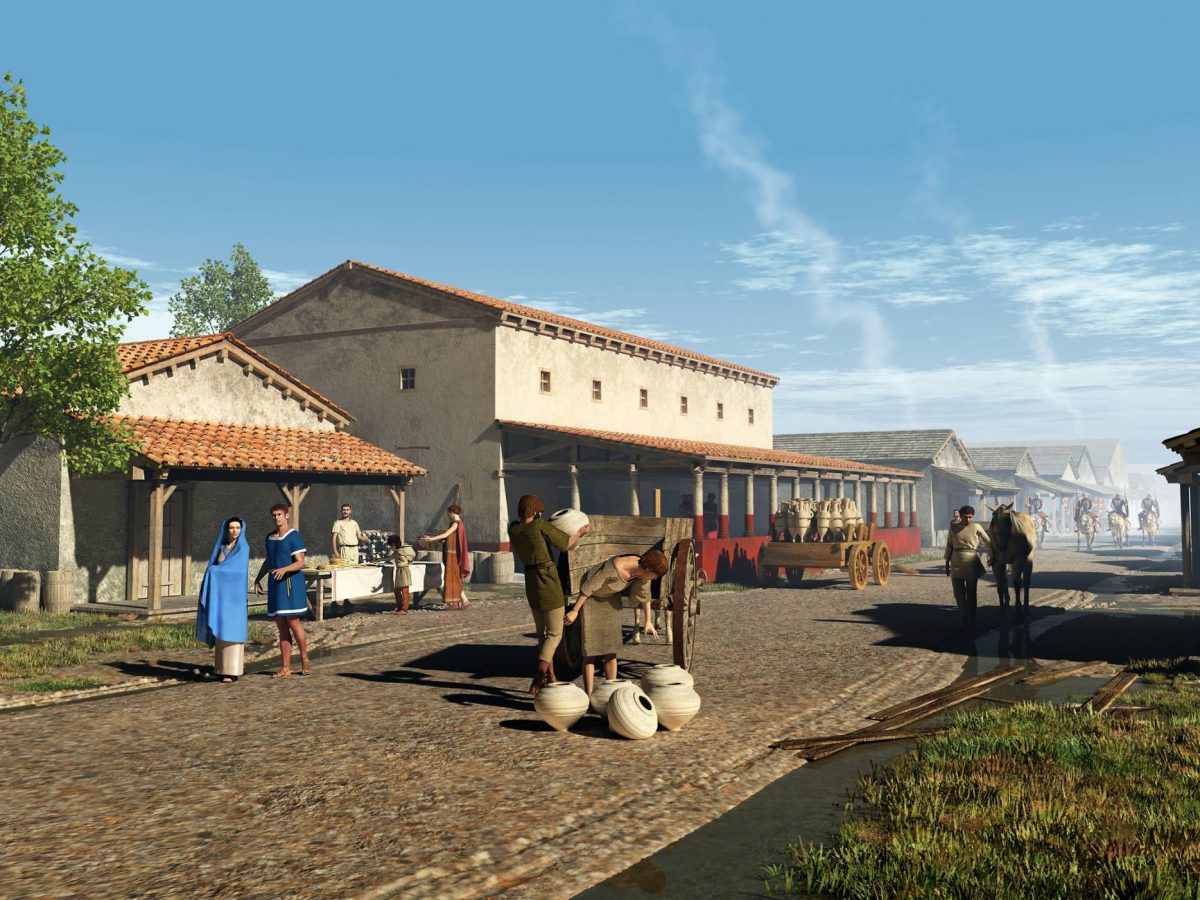
The Via Belgica was a traffic artery, because it was the most important east–west connection for the northern part of the Roman Empire. The road was a crawling lane for heavy freight traffic and also had to make room for mule trains of merchants, herds of livestock, pedestrians and hurried couriers on horseback. And then the army, with its troop movements, also claimed its place. A cohort on the march, for example, consisted of about 480 men plus dozens of wagons with weapons, pontoons, supplies and tents. Everyone on the Via Belgica had their own travel speed and space requirements. The hustle is therefore easy to imagine, especially in the settlements and for instance in Heerlen, with its crossroads of the Via Belgica and the Xanten–Trier road. The bridges over the Meuse and the Worm were bottlenecks, and there it must have been especially crowded.
Photo: Reconstruction of a Roman cart in Vejle, Denmark.
Source: Wikicommons.
Where did all those pedestrians, coachmen and riders come from, and where were they going?
The riders, for example, belonged to the state service cursus publicus. This service delivered messages on behalf of the emperor to officials and served as a taxi service for civil servants. Cologne and Tongeren were important administrative centres, as was Xanten. There was much freight traffic to and from Maastricht, with its harbour and indispensable bridge. The grains from the large farms along the Via Belgica, and the natural stone from the quarries in the Worm Valley, Kunrade, Valkenburg and Maastricht — all of it was transported along this main through-road.
.
There was much freight traffic to and from Maastricht, with its harbour and indispensable bridge.—
Just curious: what was on all those wagons and pack saddles?
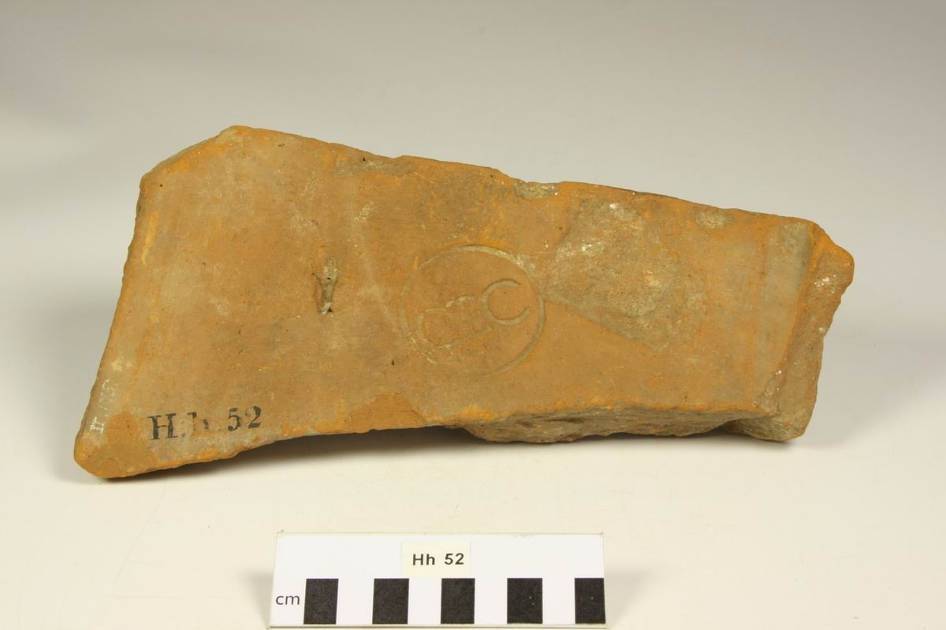
An unbelievable amount. Because everything needed to live passed along the road. To give you an impression: thousands of cubic metres of gravel from local quarries for construction and maintenance of the road. Natural stone such as marl, Kunrader stone, Nivelsteiner sandstone; brick; roof tiles from kilns in the Meuse valley. Large quantities of construction and firewood, and building timber from the Ardennes. Iron ore from places like Camerig, Holset and Elzet, for the production of agricultural tools and equipment. Local pottery from Heerlen, luxury pottery from France, glassware from Cologne. Stone for buildings and grave monuments was brought in from the Ardennes and northern France. People also had to eat, so cattle, pigs and chickens were transported. Most important were deliveries of spelt wheat, emmer wheat and barley. The large farms (in the Geul valley alone twelve have been found) each produced hundreds of tonnes of grain per harvest. In the “edible” category we must add vegetables and fruit. Luxury came in the form of olive oil from Spain in 80-litre amphorae and wine from France.
Photo: Fragment of a Roman roof tile found at the villa Backerbosch or Pannestuk in Cadier en Keer.
Source: Rijksmuseum van Oudheden.
Impressive. And how was all that transported?
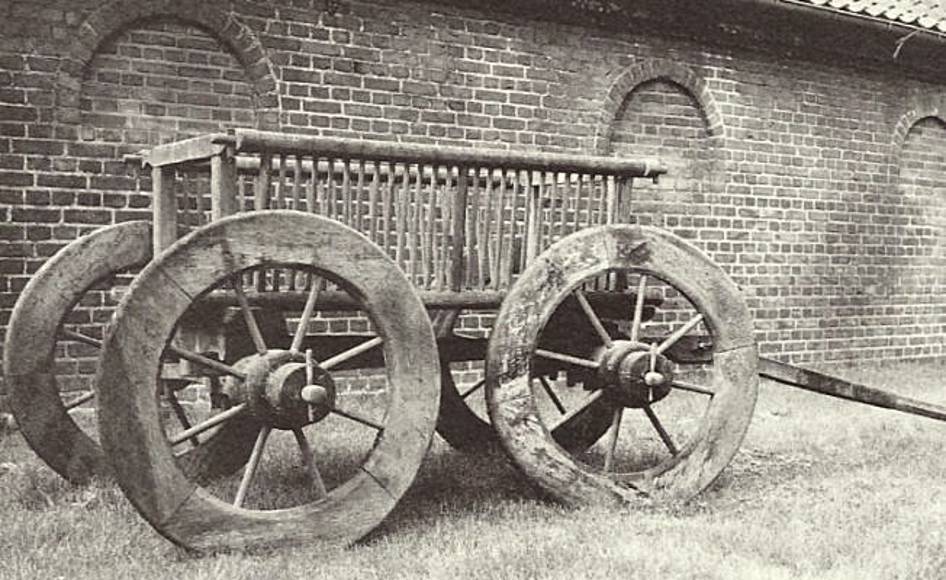
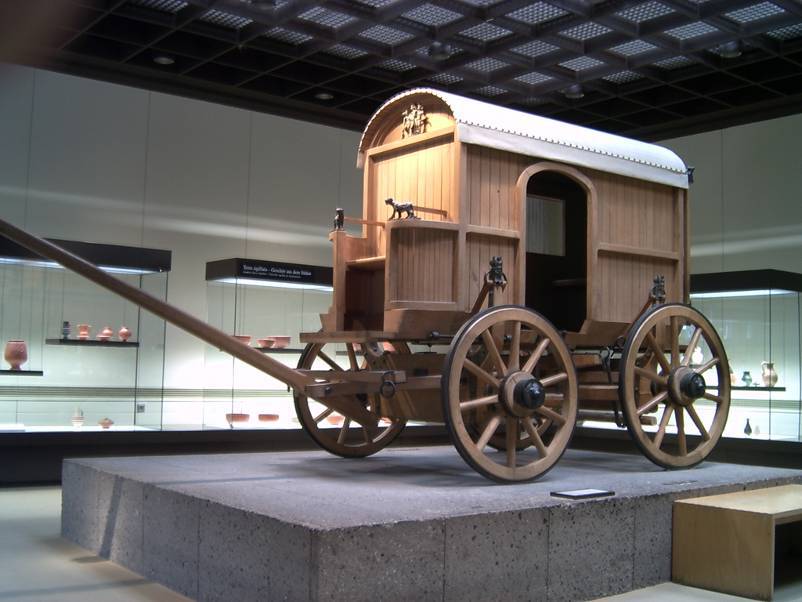
You might not expect it, but much personal travel and the transport of small items was simply done on foot. Luggage or merchandise was carried in a pack frame on the back. Those who could afford it had a mule and could place their goods on a pack saddle or even in a light cart. The well-to-do Roman who wanted to travel had a coach with one or two seats. In addition, there was an impressive range of freight carts with one or two axles. The draught work was done by oxen or by mules. The heaviest carts could carry a load of around 500 kilos. There were many variants, adapted to the cargo. Wine, for example, was transported in a large wooden barrel, amphorae or a large leather bag on the cart. The army used mule-drawn carts, because these animals walked at roughly twice the speed of oxen.
Photo: Reconstruction of a heavy travelling cart.
Source: Römisch-Germanisches Museum Cologne.
Did all transport in Roman times go over land?
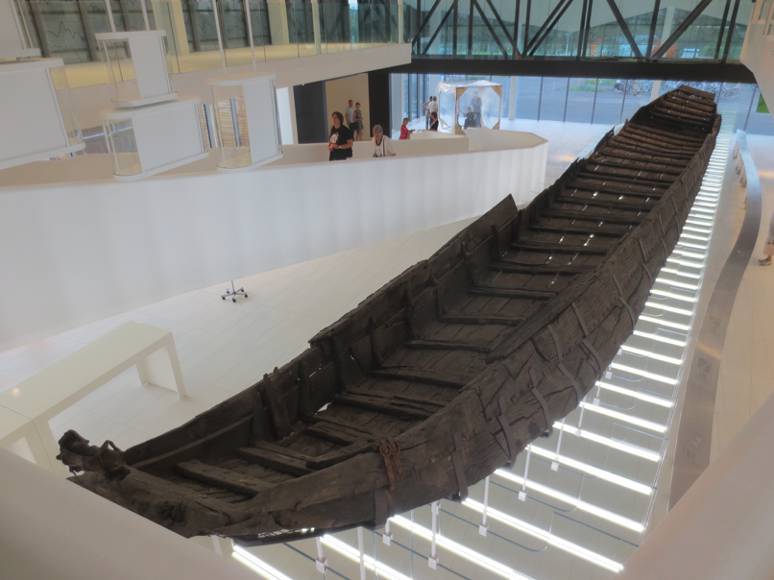
No, not at all. It was easier — especially for bulk goods or heavy freight such as natural stone — to use ships. Whenever possible, the Romans used rivers even in our region. The Meuse was important from France up to the forts along the northern frontier of the empire near the Rhine and its branches in Utrecht and South Holland. River boats have been found there — in Woerden even a boat with about 30 tonnes of grain still on board. The grain may have come from the loess region in Limburg. It is likely that smaller rivers such as the Jeker, Roer and Worm were also used for transport.
Photo: Roman river barge found near Utrecht.
Source: Aafke Holwerda / Museum De Hoge Woerd.
Transport over water — that suggests harbours
Indeed. Maastricht was an important trans-shipment point for places like Tongeren and for the farms in the region, but via the Meuse the north was also accessible. Tongeren itself is believed to have had a small trans-shipment harbour on the Jeker. The harbour in Maastricht consisted of loading and unloading places directly on the river. Wooden quays have been found there, and from a later period a heavy stone quay wall. On the quay stood wooden cranes to load and unload heavy cargo.
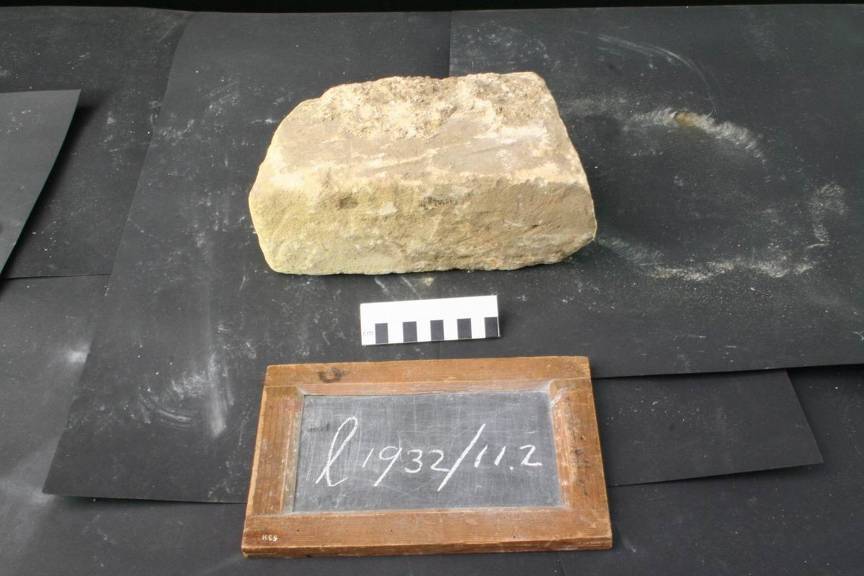
Photo: Building stone found in Voerendaal. The stone weighs 5 kilos.
Source: Rijksmuseum van Oudheden.
With thanks to public archaeologist Béatrice de Fraiture.