Leugenstone in Cologne
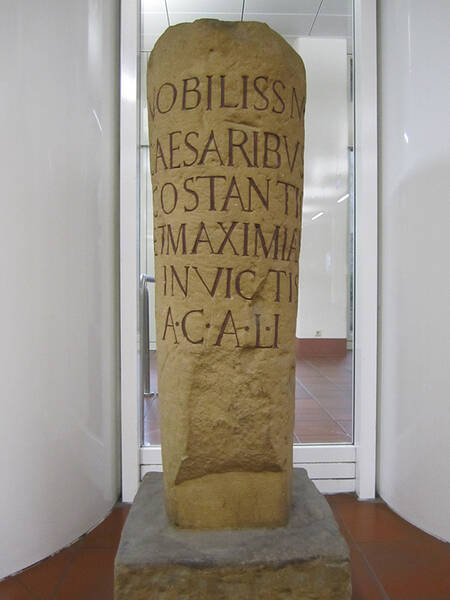
Leugenstone
NOBILISSIMIS
CAESARIBVS
CO(n)STANTIO
ET MAXIMIAN(o)
INVICTIS
A C(olonia) A(grippinensium) L(euga)
“To the noble rulers Constantius and Maximian, the Invincible. From Cologne 1 Leuga.”
A Roman milestone was discovered at the roadside near Greinstraße. Milestones, two- to three-meter-high stone pillars, primarily served as distance markers. However, they also functioned as symbols of Roman rule and, with their inscriptions, as instruments of imperial propaganda. They marked the roads along which they were erected as property of the Roman Empire. Today, over 4,000 are known, but this represents less than 10 percent of the milestones that once stood along the long-distance roads of the Roman Empire.
The inscription on the milestone on Luxemburger Straße gives the distance to Cologne not in Roman miles (1 mile = approximately 1.5 kilometers), but in Gallic leagues (1 leuga = 2.2 kilometers). The leuga was a unit of distance used in Gaul and Germania from the 3rd century AD onward. The stone was erected during the reign of Emperors Constantius and Maximian (293–305 AD), probably to mark the renewal of the road surface.
A replica of the milestone stands in the foyer of the district court in the Cologne Justice Center, Luxemburger Straße. The original is on display in the Romano-Germanic Museum in Cologne.
Fun to know
- Photo: Website Erlebnisraum Römerstraße