Roman villa Frauenthal
Roman villa in Erftstadt
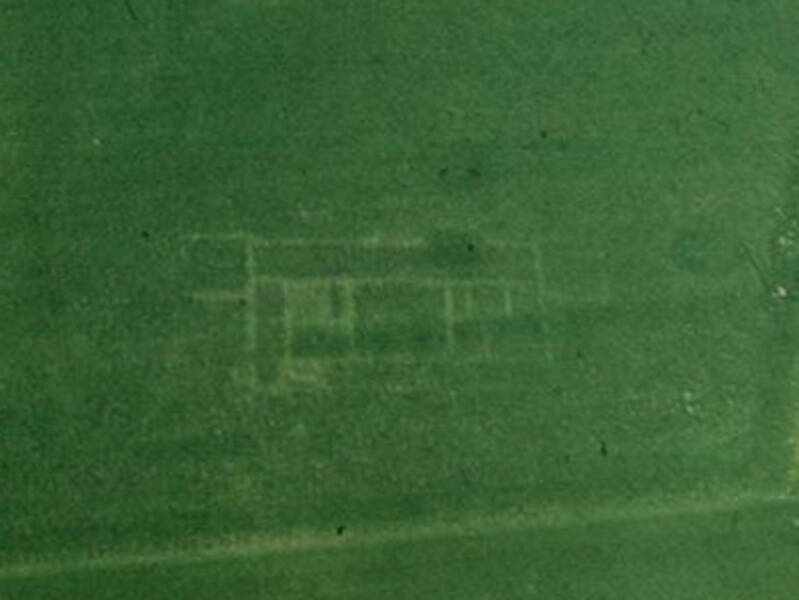
Hidden from view, yet present: The Roman portico villa in Frauenthal lies in an open field, only about 100 meters southeast of Carl-Schurz-Straße, which runs precisely along the route of the Roman road, the Agrippastraße. It was discovered in 1962 through an aerial photograph. In agricultural areas, buried wall remains often appear as light-colored strips with lower vegetation, as the plants in these areas receive fewer nutrients than in the surrounding fields.
The aerial photograph reveals a Roman-era agricultural estate (villa rustica). Ceramic finds collected from the field surface in this area confirm that the estate was cultivated from the 2nd to the 4th century AD. It consisted of a stone main building and several outbuildings, presumably made of wood. These served as dwellings for servants, stables, storage buildings, or workshops. The farmstead was likely surrounded by a ditch or hedge.
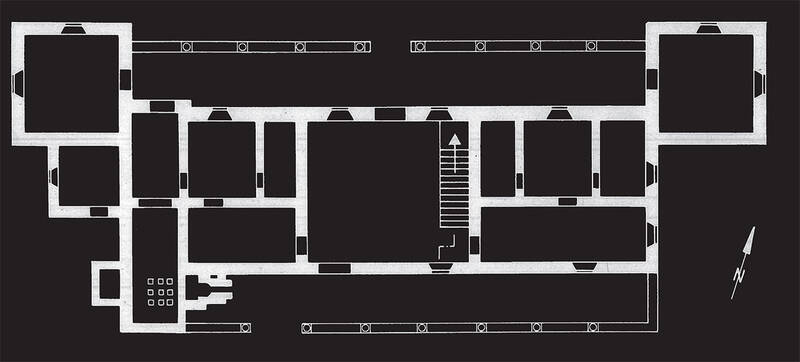
The estate owner’s residential building has a frontage of 50 meters, and the entire farm area is estimated at just under five hectares: This makes Villa Frauenthal one of the larger properties of its kind.
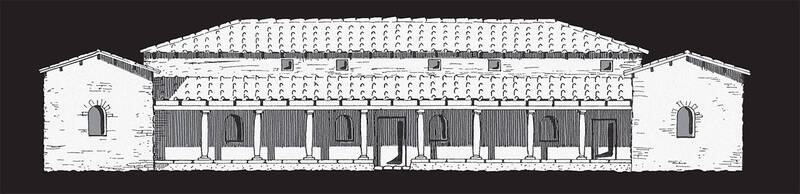
The main building was a so-called “risalit villa”—the front of the main building featured two projecting, tower-like sections at the corners, between which an open colonnade (porticus) extended. The main house, probably two stories high, contained partially heated living spaces as well as a bathroom.
Fun to know
- First photo: I. Scollar, LVR-Amt für Bodendenkmalpflege im Rheinland
- Second photo: reconstruction of the Roman villa: facade. Source: B. P. Schreiber, Archäologische Funde und Denkmäler des Erftstädter Raumes, 1999, p. 34 et seq
- Third photo: reconstruction of the Roman villa: floor plan. Source: B. P. Schreiber, Archäologische Funde und Denkmäler des Erftstädter Raumes, 1999, p. 34 et seq.