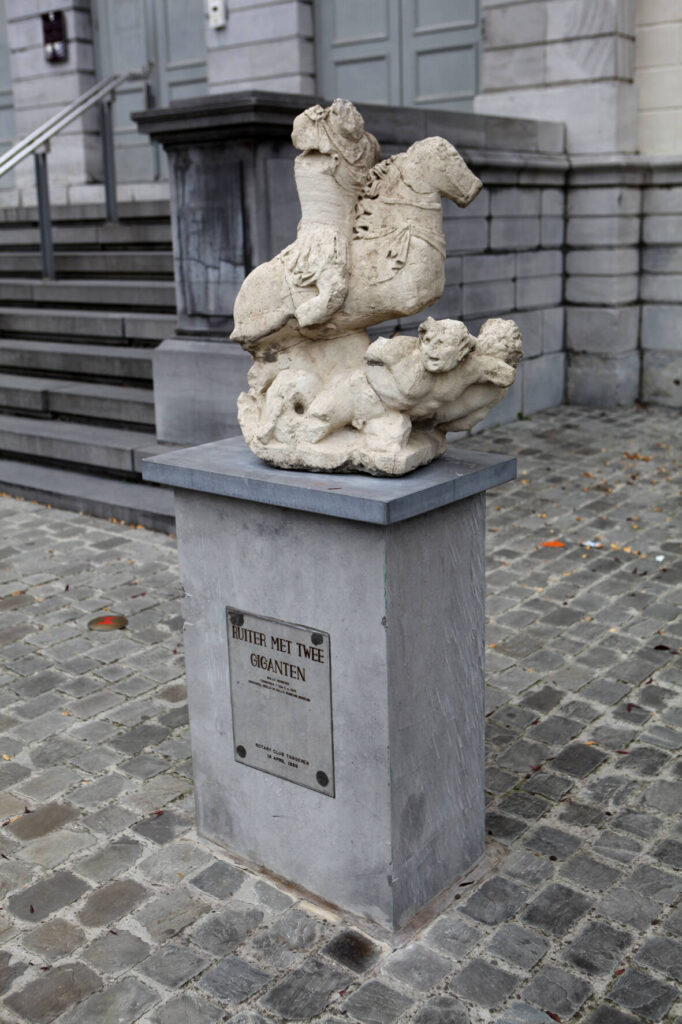
Tongeren: The Jupiter Giant Statue
Place of interest: Jupiter giant statue in Tongeren
Tongeren — the first and oldest city in Belgium. Founded by the Romans around 10 BC, it was burned down by the Batavians half a century later, only to rise again, proudly rebuilt. Tongeren became the illustrious capital of the civitas Tungrorum, the administrative district of the region, where the Mediterranean influence of Rome was undeniable: a flourishing villa landscape, a magnificent aqueduct, grand temples and bathhouses, and markets brimming with exotic goods.
Even today, the Romans are never far away in Tongeren-Borgloon. Most hotspots are just minutes apart, neatly linked by the Roman city walk. Along this city walk, you can encounter the evocation of one of the most intriguing finds from the Roman period of Tongeren: the Jupiter Giant Statue, to be found on the Vrijthof.
The Jupiter Giant Statue
The original of the Jupiter Giant Statue was discovered in the 19th century in the city of Tongeren and is now part of the collection of the Gallo-Roman Museum. The statue depicts the supreme god Jupiter on horseback, subduing a reclining giant with his thunderbolt. This type of monument, known as a Jupiter Giant Column, is mainly found in the northwestern provinces of the Roman Empire and illustrates how Roman religion and native Celtic traditions merged.
The sculpture combines classical elements with local motifs. Jupiter is shown here not as a god on a throne, but as a dynamic rider embodying the power of Rome. The defeated giant symbolizes the chaotic forces of nature and the enemies of civilization.
Such columns were typically erected in squares or near sanctuaries, where they were visible to the community and conveyed a message of order and protection to the people.
An Immersive Change to the Roman Walk, 2027
The story of Tongeren doesn’t end there. In 2027, the Roman city walk will receive a multidimensional upgrade as part of the VIA VIA project. The Roman hotspots on it will be enhanced with reconstructions and immersive storytelling. You will get an even clearer sense of the Roman road and the Roman city of Tongeren, and you will also be invited to visit the aqueduct, the Plinius springs, the Gallo-Roman temple, and other local sites. Through an app, you will see what the streets of Atuatuca Tungrorum, the capital that is now Tongeren, looked like in the second century. Your guide? An AI character from the glory days of Roman Tongeren.
Are you ready for a stroll through the past?
“We cross a modern aqueduct and reach the edge of the city. Atuatuca Tungrorum. I have dreamed of visiting the only city in the region for so long. It does not disappoint. So many colours and scents. So many sounds. Barking dogs, shouting people, the rattling carts of traders like us. The streets overflow with delights. The finest fabrics. Exotic fruits and woods. Bottles and flasks. Oil from the south. Meat, bread, and perfumes. Two women argue loudly in a language I do not understand. Men in open doorways beckon passers-by inside. The sweet aroma of a bathhouse mingles with the stench of boiling animal bones for glue. I am ecstatic and despondent at the same time. For how can we sell our wares in this place? Here, in this city that already has everything?” – Ammulva Iucunda