Via Belgica has been showing the way for 2,000 years
Author: Harry Lindelauf
Photography: Mikko Kriek
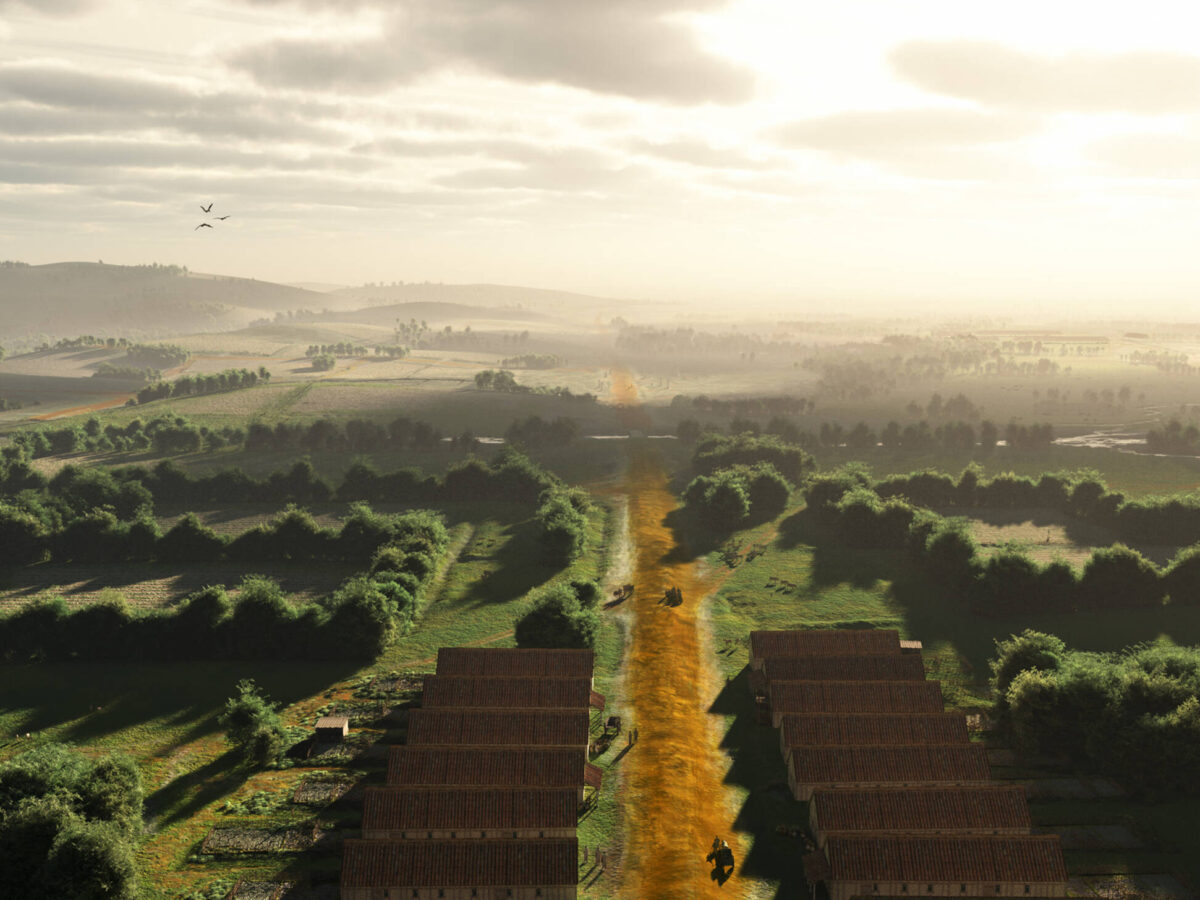
Conquerors — that is what the Romans are. They want to exercise power, crush resistance and collect taxes. And so, in conquered territory, they immediately build roads, so that the entire region is easily accessible for soldiers and officials of public administration. In planning the road network, the Romans keep two goals in mind: the army must be able to act quickly in all corners, and the roads must open up economically interesting regions. In South Limburg, too, they begin building roads after their conquests. Among these is the Via Belgica, which connects the French Boulogne-sur-Mer with the German Cologne.
Cleverly chosen
The 400-kilometre-long road has a gravel surface and is wide enough for traffic in both directions. Along the roadway lie broad strips for pedestrians and livestock. Usually the road is convex: the thickest layer of gravel is for the roadway, the thinner layers are for the sides. Skilled surveyors and engineers “read” the landscape and determine the route. When laying out the course, they cleverly make use of existing Celtic routes. They also avoid steep slopes and rivers as much as possible.
Construction begins
Supervisor of the construction is Marcus Vipsanius Agrippa. He proves to be a man of exceptional talents: he rises to general, admiral, governor of Rome, consul of Gaul and project manager of, for example, the Pantheon in Rome. The inscription above the entrance of that building names him as the builder. And what always helps, of course: he is the son-in-law of Emperor Augustus.
In 38 BC Agrippa begins work as consul in Gaul. He receives the assignment to establish Roman administration in the territories that Caesar had previously conquered. Agrippa makes plans, but they are not carried out, because he is called away for other tasks. Later he returns. Around 10 BC he sets thousands of auxiliary troops of the Roman army to work: the construction of the Via Belgica begins.
Supervisor of the construction of the Via Belgica is Marcus Vipsanius Agrippa: a man of exceptional talents.— Harry Lindelauf
Bringing all interests together
At the Strait of Dover, the road is important for the conquest of England; in Cologne it is militarily and administratively important. On the route between them lie Haspengouw, South Limburg and the Rhineland. Thus the Via Belgica opens up one of the most fertile agricultural areas of the Low Countries: the loess belt.
There, dozens of large farms are soon established that will supply grain to the army camps along the Rhine. In this way, the interests of soldiers and economists come neatly together.