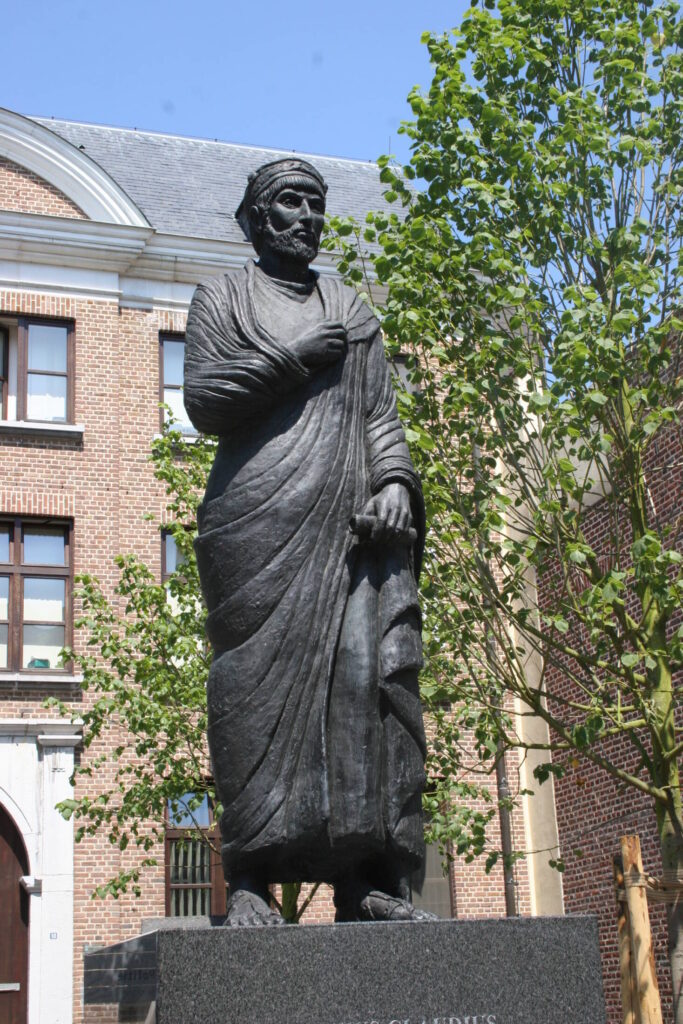
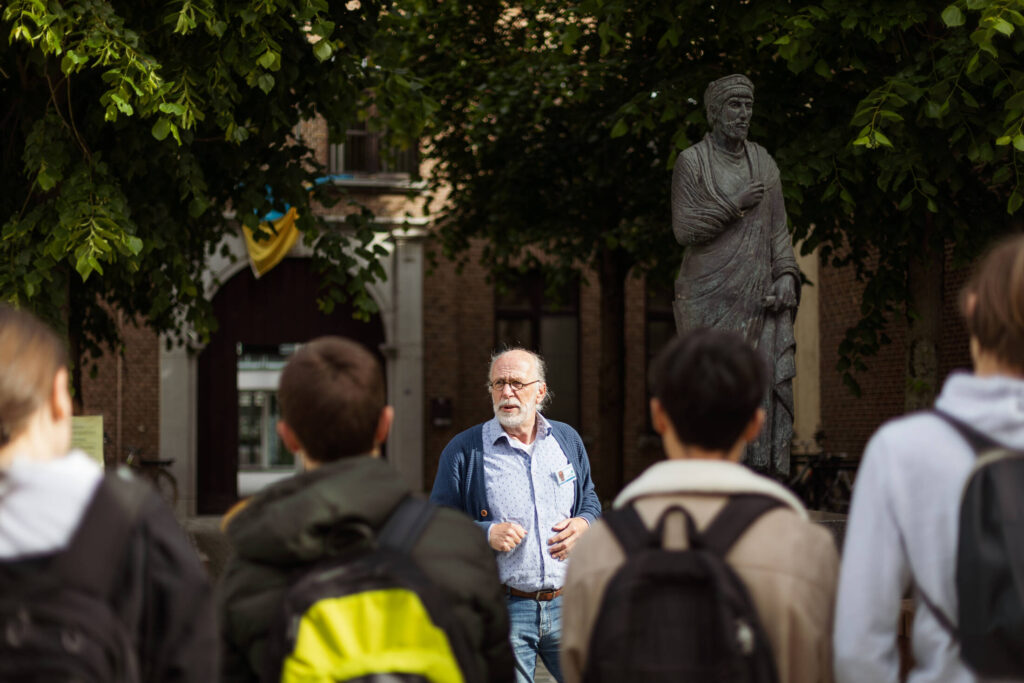
Tongeren: Statue of Julianus
Place of interest: statue of Julianus in Tongeren
Tongeren — the first and oldest city in Belgium. Founded by the Romans around 10 BC, it was burned down by the Batavians half a century later, only to rise again, proudly rebuilt. Tongeren became the illustrious capital of the civitas Tungrorum, the administrative district of the region, where the Mediterranean influence of Rome was undeniable: a flourishing villa landscape, a magnificent aqueduct, grand temples and bathhouses, and markets brimming with exotic goods.
Even today, the Romans are never far away in Tongeren-Borgloon. Most hotspots are just minutes apart, neatly linked by the Roman city walk. Along this city walk, in front of the administrative centre Praetorium in Tongeren, you will find the statue of the Roman emperor Julian, nicknamed the Apostate.
The Statue of Julianus
This bronze statue was created by the artist Monique Bleck from Genk and was officially inaugurated on 23 September 2000. With this monument, the city wanted to create a tangible reminder of an important episode from late Roman history in which Tongeren, and its hinterland, played a key role.
Emperor Julian stayed in the region in AD 358 during his campaigns along the Rhine frontier. From the south, he advanced against the Salian Franks, who had settled in Toxandria. In literary tradition, this campaign is associated with Tongeren and its surroundings, which in the 4th century still served as an important regional stronghold of Roman administration and the army. The statue thus refers to the enduring significance of the city, even after the heyday of the imperial era.
The statue depicts Julian in military attire, proud and resolute. In doing so, it embodies both his role as a commander and his symbolic place in Tongeren’s culture of remembrance. Today, the statue forms part of the Roman heritage trail and serves as a landmark that connects the city’s past and present for all to see.
An Immersive Change to the Roman Walk, 2027
The story of Tongeren doesn’t end there. In 2027, the Roman city walk will receive a multidimensional upgrade as part of the VIA VIA project. The Roman hotspots on it will be enhanced with reconstructions and immersive storytelling. You will get an even clearer sense of the Roman road and the Roman city of Tongeren, and you will also be invited to visit the aqueduct, the Plinius springs, the Gallo-Roman temple, and other local sites. Through an app, you will see what the streets of Atuatuca Tungrorum, the capital that is now Tongeren, looked like in the second century. Your guide? An AI character from the glory days of Roman Tongeren.
Are you ready for a stroll through the past?
“We cross a modern aqueduct and reach the edge of the city. Atuatuca Tungrorum. I have dreamed of visiting the only city in the region for so long. It does not disappoint. So many colours and scents. So many sounds. Barking dogs, shouting people, the rattling carts of traders like us. The streets overflow with delights. The finest fabrics. Exotic fruits and woods. Bottles and flasks. Oil from the south. Meat, bread, and perfumes. Two women argue loudly in a language I do not understand. Men in open doorways beckon passers-by inside. The sweet aroma of a bathhouse mingles with the stench of boiling animal bones for glue. I am ecstatic and despondent at the same time. For how can we sell our wares in this place? Here, in this city that already has everything?” – Ammulva Iucunda