Heidenburg in Bergheim
Heidenburg
About 26 kilometers west of the provincial capital Colonia Claudia Ara Agrippinensium (Cologne), there was a settlement in Roman times known as the vicus of Elsdorf. Here, the Via Belgica was flanked on both sides by continuous rows of buildings. Long, rectangular strip houses were oriented with their narrow sides facing the road, and a shared colonnade (porticus) ran along the street, providing pedestrians with shelter as a covered walkway. Comparisons with other vici in Lower Germania suggest that individual houses were at least 25 meters long. It can be assumed that the rear parts of the plots in the vicus of Elsdorf were also used as gardens or as sites for craft production, such as pottery.
At a distance of about 90 meters from the Via Belgica stood a Gallo-Roman ambulatory temple. This sanctuary consisted of a rectangular room measuring 8 × 10 meters, surrounded by an approximately four-meter-wide surrounding corridor. Whether this corridor took the form of a colonnaded walkway or an enclosed passage—as was often the case—is not known, since only the foundations of the temple have survived.
While the residential buildings were aligned at right angles to the Via Belgica, the more distant Gallo-Roman ambulatory temple and several nearby structures show a different orientation. It appears that these buildings were not aligned with the Via Belgica, but rather with a secondary road that has not yet been identified. This suggests that the vicus of Elsdorf may have been located at a road junction in Roman times. Along this secondary road—which joined the Via Belgica from the southwest at an acute angle—the sanctuary and other buildings were situated.
Fun to know
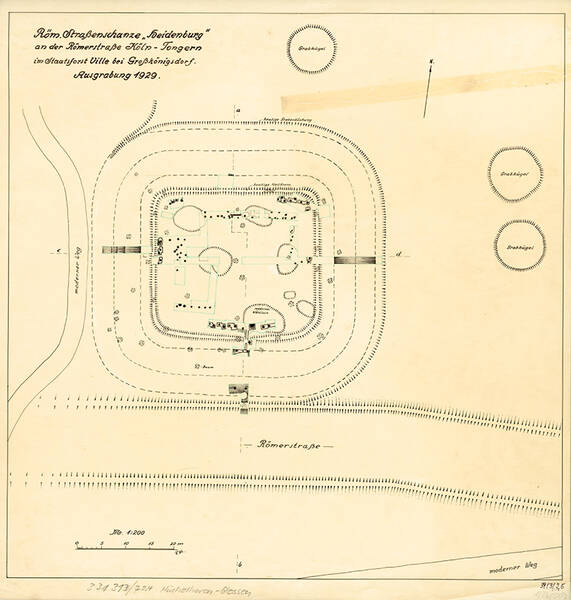
- First photo: Military roadpost "Heidenburg": Map based on excavation finds. Image source: LVR Bureau for Archaeological Heritage Management in the Rhineland.
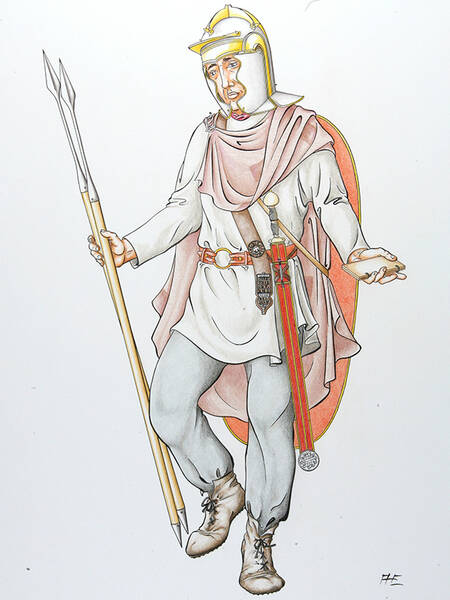
- Second photo: Roman soldier (3rd century). Image source: F. Hilscher-Ehlert, LVR-LandesMuseum Bonn