St. Mary’s Assumption / Market Square in Jülich
St. Mary’s Assumption / Market Square
Nearly 2,000 years of settlement history have left their traces on this square: since the Renaissance, the market of the town of Jülich has once again been located at the same site that already formed the center of the settlement in antiquity.
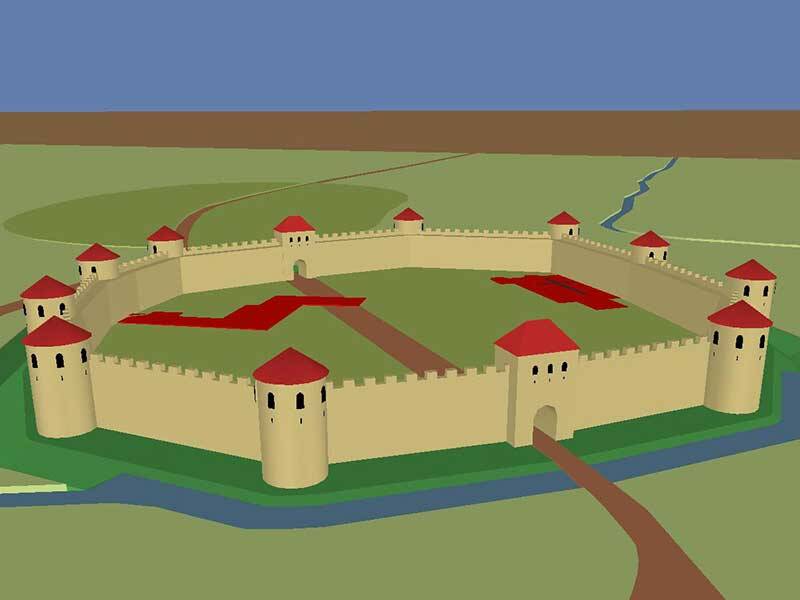
In the Middle Ages, the old market (Altmarkt) was situated in front of the fort at the corner of Düsseldorfer Straße and Kapuzinerstraße. However, after the great fire of 1547, the town had to be completely redesigned. In the process, the market was moved back to its original location as the city’s central point. During the construction of the Old Town Hall, the Roman main road was uncovered there. Its further course is now marked in the paving of the market square. In the 4th century, the walls of the late Roman fort ran around the market—gray strips on the four streets leading off the square today indicate their former course. Altogether, more than two meters of settlement debris lie here in what was once the center of the Roman settlement.
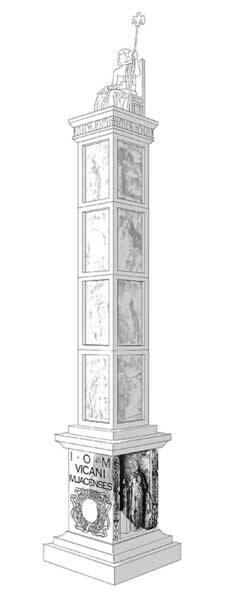
The fort continued to be used into the High Middle Ages. Along one section of the wall stood a Roman building from which the Romanesque Church of St. Mary’s Assumption developed. During this period, Roman structures were used as quarries for building stone: for example, next to the church’s side entrance, a fragment of a Roman votive stone with a cornucopia relief can still be seen. On the base of a Jupiter column, found in the foundation area of the church, there is an inscription that mentions the name of Jülich for the first time: “To the highest Roman god, the inhabitants of the vicus of Jülich, the vicani Iuliacenses, erected this column.”
The small columns in the tower hall, dating from around 1150, are made of so-called “Cologne marble”—an imitation marble produced from the limestone deposits of the Roman Eifel aqueduct.
Fun to know
- First photo: reconstruction of the Column of Jupiter, erected by the inhabitants of Iuliacum, 2nd century. Graphic: N. Bartz
- Second photo: digital model of the late antique fort, 4th century. Image: Prof. U. Stegelmann, Forschungszentrum Jülich