Roman Building: a Cultural Line in Architecture
Author: Loes van Oort
Photography:
“Good building has three requirements: firmness, convenience, and delight.” Many architects still like to quote these words of Vitruvius, written around 25 BC in his manual Architectura. Ten Books on Architecture.
The book is a true classic but still very relevant, says architect Lotte de Moor. “It is of course very special that more than two thousand years later you can read a book by a colleague architect. But above all, I find it fascinating that many themes can be translated one-to-one into current practice.”
That Vitruvius wrote such an extensive guide to buildings says a lot about the level at which the Romans thought about architecture. Urban planning, building materials, houses, and technology are only some of the topics Vitruvius discusses in the ten parts that make up Architectura. They are the written proof of the highly praised Roman building skills, still to be admired in full glory mainly in Italy and its surroundings.
In the hills of South Limburg too, the Romans brought major changes to the built environment. Yet this image should not be imagined too romantically, De Moor explains. “The Romans who settled near the Via Belgica did not immediately and radically change the building style of the region. The influence of Roman architecture grew over time, but there was never a completely pure architectural style.”
Addicted to the Past
Although De Moor studied archaeology for three years, she emphasizes that she is not an archaeologist. She began the study out of her great interest in history—an interest she already had as a child— but left somewhat disillusioned. “It was mainly a lot of theory and little practice; I had imagined something else.”
At the art academy in The Hague she discovered her design side during the architectural design program. Later she completed a master’s in architecture at the Academy of Architecture in Maastricht. There she met her life partner, with whom she now runs the firm Vullings De Moor.
“For centuries architecture has adapted organically or moved along with social and societal developments in a region.”— Loes van Oort
“From our firm we see architecture as a continuous cultural line. For centuries architecture has organically adapted or moved with social and societal developments in a region.”
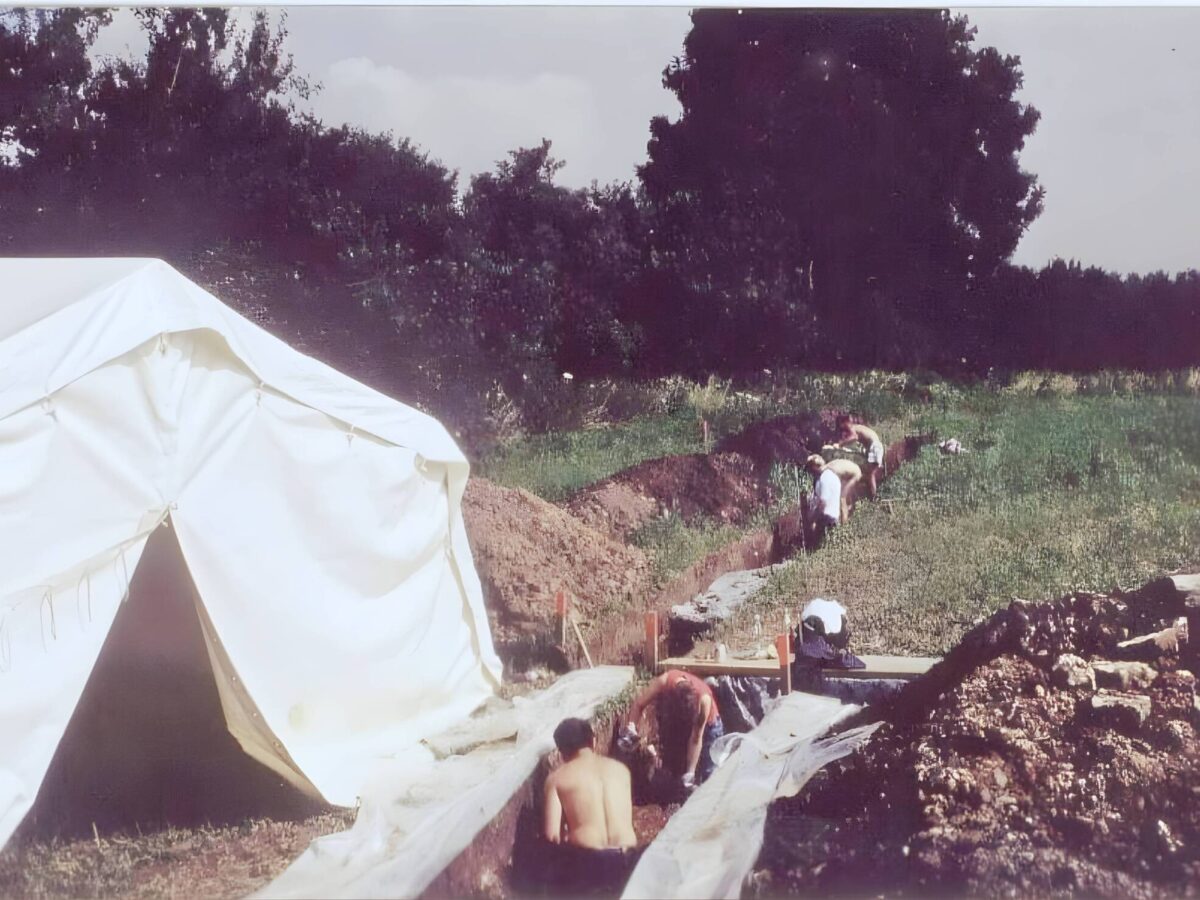
That De Moor has immersed herself in Roman history is no surprise given her fascination with the past. Yet she also has a current reason that further stimulates her curiosity. “I am helping my family with the current design task at Heerdeberg, where I also live with my family. The Romans left their traces here, and we want to use this value in a fitting way for the new function of the estate.” A grateful task, De Moor says.
The Most Basic Form of Living
And so she dives into the literature. A pleasure, she says, especially when it comes to Vitruvius’ philosophical musings. “The way he speaks about ‘the primitive hut’ as the archetype of human dwelling is still relevant, and a theme architects still deal with today.”
As a result of the discovery of fire people began to gather… so that more people came together in one place… In this community some then began to make little roofs of foliage, others… looked at swallows, how they built their nests, and made dwellings of clay and twigs… Then they looked at the housing of others; by adding new ideas to their own inventions they developed better kinds of huts day by day…
After the first steps had thus been taken, and because nature had equipped humans not only with senses like the other living beings, but had also armed their mind with reason and deliberation, and had subjected other living beings to their power, they were afterwards able to pass from the construction of houses step by step to other arts and sciences.
— Architecture manual, translated by Ton Peters. Athenaeum – Polak & Van Gennep, Amsterdam 1997.
South Limburg as a Melting Pot
Back to here, the south of Limburg, the Via Belgica. What did Vitruvius and his fellow architects bring to this region? Directly very little, but indirectly quite a lot, De Moor explains.
“When the Romans occupied this area, there were mainly small autonomous agricultural settlements. The Eburones who lived here built with perishable materials such as wood, wicker, clay, and reed. Houses usually had one large space with areas for people and livestock.”
With the arrival of the Romans, various ‘unofficial’ towns arose along the Via Belgica. Not administrative centers (civitates), but so-called vici—such as present-day Heerlen and Maastricht—towns that developed where important routes crossed.
Because of the great demand for food, especially grain, for the soldiers on the Roman frontier, a large market emerged for local farmers in the present-day hill country. Farms grew in scale and the prosperity of landowners increased. This prosperity—combined with the location along an important road—led to more trade and the rise of production centers with potters, smiths, and carpenters: the vicus was born.
Organization and Specialization
It was especially the great degree to which the Romans could organize and specialize that influenced architecture, says De Moor. “People could afford another craft alongside their own maintenance. Agricultural life no longer required all their time. This allowed them to build in a different way, both technically and financially.
Moreover, this organization and specialization improved technology and production capacity, for example in roof tiles. And prosperity helped too, because people could buy something if they could not make it themselves.”
The Romans also knew how to handle the raw materials they found here: they made roof tiles from baked clay, used Kunrader stone for walls, and marl for cement and mortar. Yet around the Via Belgica, not all houses suddenly became stone buildings with right angles. “As always in history, architecture changed organically. The ‘modern’ techniques and materials were combined with existing techniques such as timber framing with willow-wattle, finished with clay plaster that was whitewashed.”
In terms of comfort and aesthetics, the Romans also brought new flair. The clever hypocaustum system is underfloor heating avant la lettre: ingeniously built hollow spaces in floors and walls were pleasantly heated with fire. The introduction of toilets and window glass also provided a more comfortable life.
With interior decoration, the Romans likewise excelled: buildings received beautiful wall paintings and decorated mosaic floors. But De Moor adds a note of caution: these features applied only to some public buildings, such as the bathhouse, or the truly wealthy houses and villas.
“The decoration and luxury of the villa rustica is modest compared to the country houses of ancient Rome.”— Loes van Oort
Rustica versus Urbana
The villas scattered throughout this region also need clarification. “A villa sounds chic, but in this agricultural context it refers to the so-called villa rustica, a large manor farm with outbuildings such as a horreum (granary).
The main building was usually of stone, but the decoration and luxury remained modest compared to the country houses we know from ancient Rome.”
The Romans also had a more luxurious version of the villa: the villa urbana, meant to escape city life and find relaxation in the countryside. Pliny the Younger (62–113 AD) was a senator, orator, and owner of various villas near Rome. In several letters he described life in his country houses so vividly that the Plinian villa became a concept—an ideology in which the villa symbolizes escape from daily obligations.
“Dearest Domitius Apollinaris,…
At the head of the colonnade lies a dining room. Its French doors overlook the end of the terrace with immediately a meadow and much open land; through one window you see the side of the terrace and the projecting part of the villa, through the other the trees and foliage of the adjoining racetrack… And apart from what I mentioned, there is also this: the deep peace there! So rich and full and thereby so carefree! No need for a toga, no neighbors calling upon you, all peace and calm… There I am at my best, in mind and body… Warm greetings, Pliny.”
“Letter 5.6; date: 105.” Pliny. “My Country Houses”, Vincent Hunink. Athenaeum–Polak & Van Gennep, Amsterdam 2017.
Back to Basic—or Not?
De Moor sees many of Pliny’s desires reflected in today’s drive for peace and space in the countryside. “When I read this, I cannot help but see connections with how we live now. How many people leave the hustle of the city behind and consciously choose a quieter life outside.
Also the desire to be self-sufficient—in energy and food—is a development that parallels this ideology.”
But the way the Romans shaped their environment also shows what the need for comfort and luxury brings, says De Moor. “Of course they used local materials, but for optimal comfort or aesthetics they also imported materials like natural stone or pigments.
With their new way of building and living, the Romans brought us the first form of globalization, trade, trends, and market forces. Things that have now grown so exponentially that we long again for the local and small-scale.”
“As architects we also strive to keep the footprint of a building as low as possible and to work with local materials and craftsmen. But are we also willing to give up a degree of comfort and adjust our values? I find it immensely interesting how the Romans, with their ideas, prompt us to think again today.”
The Long Line
From the idea that architecture develops organically, De Moor finds it fascinating how Roman buildings in this region eventually disappeared.
In the third century AD, Germanic tribes gained increasing control of the region through their attacks. The Romans responded by establishing forts in cities such as Maastricht. The areas outside these defended places became unsafe, causing villa owners to leave, and many villas were plundered and burned.
“With the loss of their position in the region, the Roman building culture initially disappeared as well. Yet many building methods we now take for granted can be traced back to classical times, such as bricks, roof tiles, arch construction, and the use of concrete.
Their innovation and ingenuity have evolved over the centuries and inspire us in our own architectural practice. Because you can only continue a line if you understand where it once began.”