Brits Engels Roman Bocholtz Exhibition – Display Case 2
Hoeve Overhuizen - Bocholtz
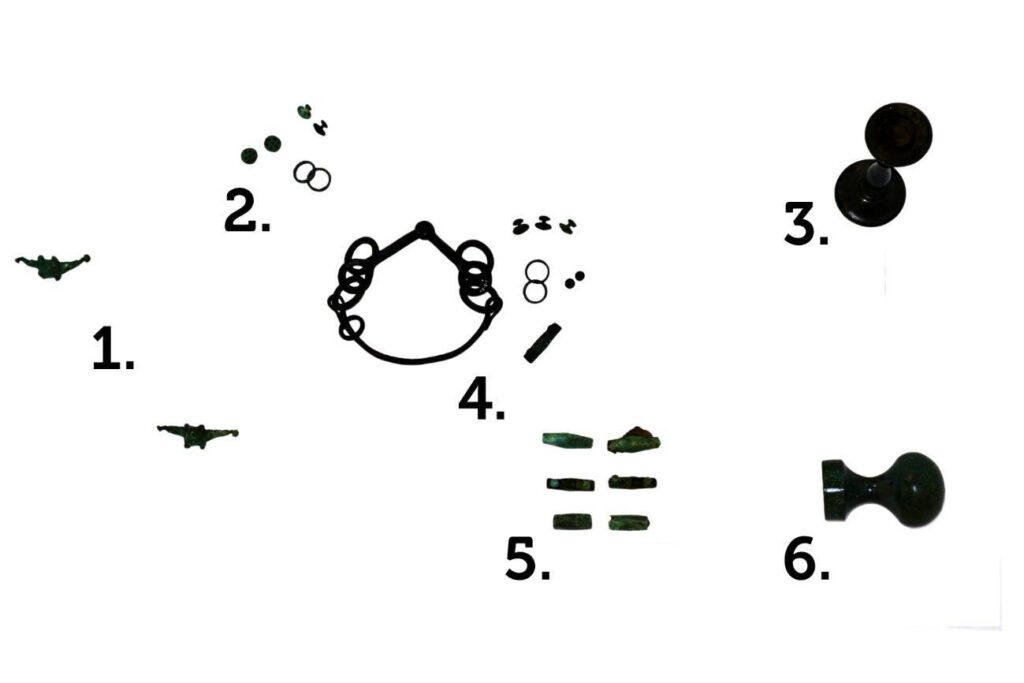
1. Riding Spurs
Mid-2nd century AD
Original, Provincial Archaeological Finds Repository Limburg
Two riding spurs were found among the grave goods of the Lord of Bocholtz. Riding spurs are extremely rare in Roman graves. This type of Roman spur is known as a button spur, named after its distinctive shape. These metal fittings with projecting points were attached to a rider’s footwear. By nudging the horse with them, the rider encouraged it to gallop faster.
2. Horse Harness
Mid-2nd century AD
Original, Provincial Archaeological Finds Repository Limburg
Various horse harness fittings, consisting of two rings, a clasp inlaid with glass paste (four red and two black dots surrounding a central black dot), and two additional clasps.
3. Stand for an Oil Lamp
Mid-2nd century AD
Original, Provincial Archaeological Finds Repository Limburg
Indoors, the oil lamp was the primary source of light during the Roman period. This oil lamp, however, is far from ordinary—it is genuinely rare. North of the Alps, very few Roman bronze oil lamps have been discovered. A bronze oil lamp was a true luxury, as most lamps were made of pottery.
4. Horse Bit
Mid-2nd century AD
Original, Provincial Archaeological Finds Repository Limburg
Five iron and bronze rings, a bar, and a mouthpiece, together with several loose components, form a horse bit. The bit was placed in the horse’s mouth and attached to leather reins, allowing the rider to restrain the horse if it reared.
5. Horse Harness
Mid-2nd century AD
Original, Provincial Archaeological Finds Repository Limburg
Various horse harness fittings, consisting of two long hollow beads (rounded on the upper side and flat underneath), two fitting fragments (semi-circular hollow tubes with two small rivets), and two biconical ferrules (octagonal components of a horse harness).
6. Knob
Mid-2nd century AD
Original, Provincial Archaeological Finds Repository Limburg
Function unknown. Brown, dark green and grey in colour, with light green pitting. The knob is hollow, with a drilled hole at the top and another through its narrow central section, while the underside has a wide opening. It is exceptionally sturdy, heavy, and complete.