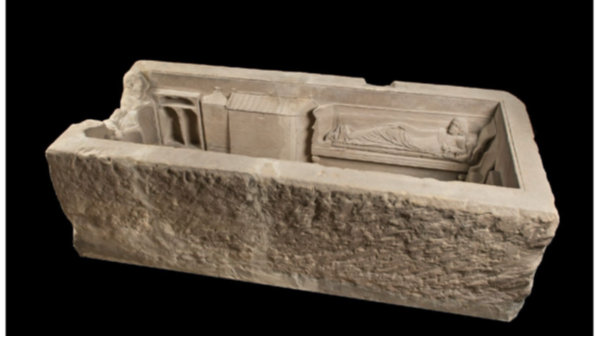
Sandstone cinerary urn of the Lady of Simpelveld
Lange Graaf, Simpelveld
Nestled in the rolling hills of South Limburg, Simpelveld lies at the heart of one of the richest Roman landscapes in the Netherlands. Nearly two thousand years ago, this fertile region formed part of the Roman province of Germania Inferior, crossed by the important Via Belgica and dotted with prosperous villa estates. Archaeological discoveries in and around Simpelveld reveal a thriving rural elite whose Roman way of life left lasting traces in the landscape.
From luxurious villas and burial monuments to exceptional funerary finds such as the Lady of Simpelveld and the Lord of Bocholtz, the Roman past here is unusually personal.
The Lady of Simpelveld
Simpelveld, December 1930.
While digging on his land, a local farmer strikes stone— or so he believes. What he unearthed was no ordinary stone, but a sandstone cinerary urn over two metres long. Grave robbers have drilled holes into the side, yet part of the grave goods remains: gold jewellery, a silver mirror, a glass bottle, a pottery flask… At the bottom lie cremated remains – of a woman.
This remarkable discovery became known as the Lady of Simpelveld. Her urn is extraordinary not only for its contents but also for its decoration: a carved scene is depicted on the inside. A rarity, for in Roman practice, reliefs were typically carved on the outside.
The high relief depicts the interior of a chamber. A woman – the deceased – lies on a couch. She is surrounded by a chair, a chest, shelves, a side table, and a cupboard with two doors. Wooden furniture carved in stone. Thanks to this chest, archaeologists can finally see what such furniture once looked like. At the foot of the couch, a Roman villa is also represented. Seven years later, traces of a Roman villa were discovered near the findspot, perfectly matching the image on the sarcophagus.
Today, the original sarcophagus is preserved in the National Museum of Antiquities in Leiden, a copy of the original can be found in the Information Centre Hoeve Overhuizen. It remains unique in the Roman world: a personal interior scene transformed into eternal stone. The Lady of Simpelveld teaches us that the Roman lifestyle of villa dwellers extended even into death. The remains of the deceased were laid in stone cinerary urns or wooden burial chambers, which were set within monumental walled tombs near the villa. Less affluent graves, by contrast, were simply marked by ditches or enclosures.