Markt 46 (Five Guys) – Late-Roman Castrum and Settlement Continuity
Markt 46 (Five Guys), Aachen
The name Aquae Granni, the Roman precursor of modern-day Aachen, points to Roman Aachen’s greatest asset: its hot springs! The mineral waters were quickly believed to have healing powers. Granni refers to Grannus, a Gallic deity associated with health and recovery. The earliest thermal baths date to around the turn of the millennium. From the outset, the Romans envisioned Aachen on a grand scale: even at its founding, the town had the air of a true city – 30 hectares in size, with wooden houses, thermal baths, and even a stone bathhouse with tiled roofs.
A City Growing Around Its Baths
In the early second century, Aquae Granni underwent a complete urban renewal. Emperor Trajan may have intended to elevate the vicus to a regional capital – a theory supported by stamped bricks and an inscription bearing his name. The original baths made way for a monumental square of more than 6,000 square metres, likely containing a forum and temple. Across the city, monumental new bath complexes were built.
Aquae Granni became one of the Roman Empire’s leading wellness centres and the only major spa in Germania Inferior.
The Late-Roman Castrum at Markt 46
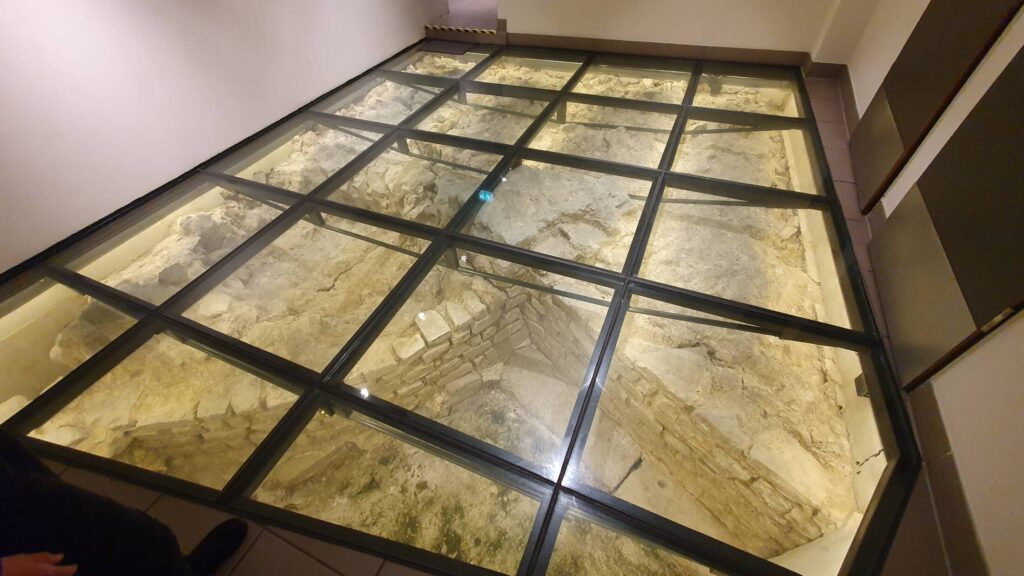
As Aquae Granni developed into a bustling urban centre with monumental baths and a civic forum, the city also needed defensive structures to protect its citizens and infrastructure. At Markt 46 in the anteroom to the restrooms of the restaurant “Five Guys”, you can see under a glass floor the remains of the late-Roman castrum’s perimeter wall, including the base of a round tower and an attached high-medieval wall. This castrum later became part of the royal palace in the Early Middle Ages and was not abandoned until the 12th century. The site demonstrates the continuity of settlement in Aachen, linking the city’s Roman urban planning, civic life, and fortifications to its medieval successors.
Discover Roman Aachen on the VIAVIA Route, 2027
The Markt 46 site is a key stop on the VIA VIA Roman City Walk route of Aachen, which links the museum exhibit in Centre Charlemagne to the city’s archaeological remains. Along the trail, you can explore other highlights, from Roman walls and floors in the Elisengarten to the Münsterthermen inside Aachen Cathedral. Informative panels, multimedia displays, and encounters with Roman “characters” provide context, illustrating Roman administration, urban development, bathing culture, and the late-Roman castrum. The preserved remains at Markt 46 offer a tangible glimpse into Aachen’s defensive and civic life, connecting the Roman city to its medieval successors.
Are you ready to take a walk?
“‘The city smells of rotten eggs,’ Julia grimaces. My daughter is right. The thermal baths of Aquae Granni may be healing, but their sulphurous stench is unbearable. It doesn’t seem to bother the bathers, though. Our cart moves forward at a crawl through a crowd of shuffling people and wagons piled high with wood. ‘Most of it is for the baths,’ says a dark-skinned man walking beside us. ‘Every day, the thermae and the underfloor heating of the rich devour another piece of the forest. The baths heal the body, but not nature,’ he sighs, before vanishing again into the throng. Quintus Iulius has come up with the idea of bottling the spring water and selling it at the markets of Germania Inferior. Personally, I’m just looking forward to sliding into the warm water for a few hours — and talking with people from all corners of the Empire. Perhaps I’ll overhear some news about the situation in Rome. They seem to change emperors every few months this year. Murder and decapitation — not even the most curative water can wash that away.” – Ammulva Iucunda
Fun to know
- Photo of the glass floor panels was taken by Stadtarchäologie Aachen.