Roman Bocholtz Exhibition – Display Case 3
Hoeve Overhuizen - Bocholtz
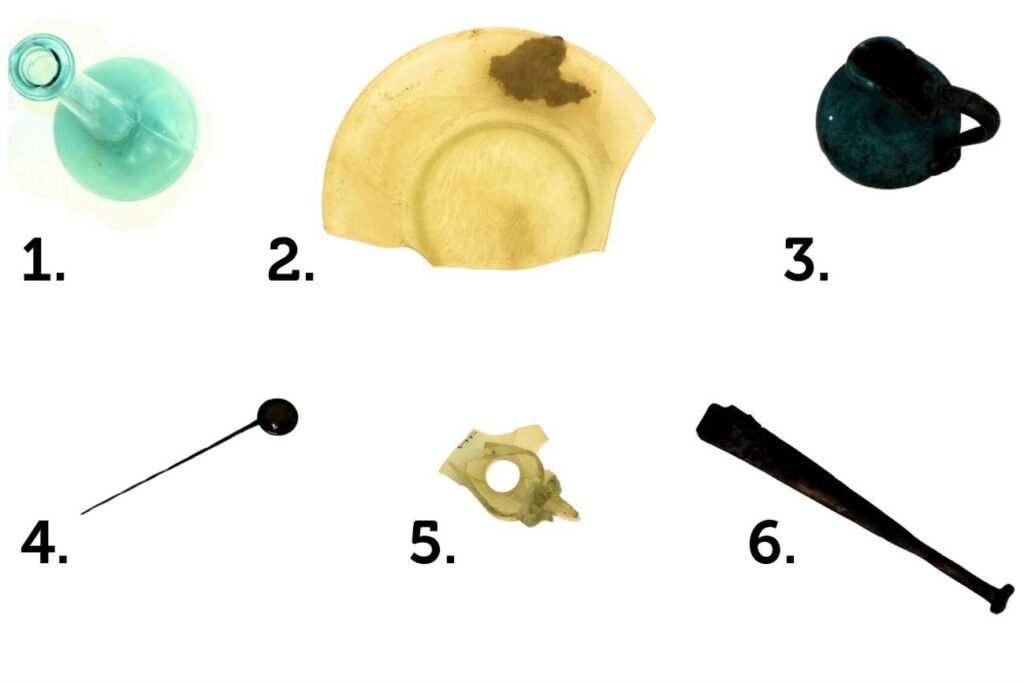
1. Tear Bottle / Unguentarium
2nd–3rd century AD
Original, Provincial Archaeological Finds Repository Limburg
This light greenish-blue glass bottle was found inside the ash chest of the Lord of Bocholtz. Contrary to what its name suggests, it was not used to collect or preserve tears. In reality, bottles like this contained precious scented oils, perfumes or medicinal balms. The long neck prevented too much of the contents from being poured out at once. These bottles were placed in graves as grave goods because it was believed that personal grooming rituals continued in the afterlife.
2. Bowl/Plate with Rounded Rim and Sloping, Outward-Flaring Sides
2nd–3rd century AD
Original, Provincial Archaeological Finds Repository Limburg
Colourless glass with a greenish/yellowish tint, a base ring and outward-flaring sides. This object belongs to the category of Roman fineware: luxury household objects that testify to craftsmanship and refinement. It is an Isings 80 type glass vessel, distinguished by its exceptionally thin glass walls. Producing glass of this quality required considerable expertise, making these costly objects accessible primarily to the wealthier sections of society. Because of their fragility, complete examples are rare. This makes the condition of this object, which is 75% complete, particularly significant.
3. Pouring Jug
Mid-2nd century AD
Original, Provincial Archaeological Finds Repository Limburg
This copper jug forms a set with the washing bowl displayed in the case beside the lid of the Lord of Bocholtz’s ash chest. Together, they were used for washing hands or making an offering. In the latter case, the jug would have been filled with wine. The ends of the handle are decorated: at the bottom with the head of a person or child, and at the top with the head and paws of a lion-like animal with ram’s horns.
4. Spoon / Cochlear
Mid-2nd century AD
Original, Provincial Archaeological Finds Repository Limburg
This small silver spoon, with its decorated bowl and long, pointed handle, is relatively rare. The Latin name for this type of spoon is cochlear, a word referring to a spiral. It is therefore thought that these spoons were used to extract snails – already considered a delicacy in Roman times – from their spiral shells. Such a luxury spoon may have formed part of the tableware of a Roman army officer. A particularly interesting feature of this spoon is the letter R scratched into the back of the bowl.
5. Pouring Jug / Brocca
Mid-2nd century AD
Original, Provincial Archaeological Finds Repository Limburg
Single-handled, globular jug with a pinched spout and globular body, Isings 88b, made of colourless glass and without a base ring.
The jug has a globular body, a handle with a vertical thumb rest, a trefoil-shaped spout and two horizontal grooves cut into the body. It is incomplete and fragmented; parts of the body, spout and handle are missing.
6. Wax Spatula / Stilus
Mid-2nd century AD
Original, Provincial Archaeological Finds Repository Limburg
Iron, long flat spatula of triangular form, ending in a head that is circular in cross-section and flattened underneath. The object is complete apart from a small missing corner at one end and has been conserved. The Romans used a wax spatula to erase mistakes and smooth the wax surface of a writing tablet.
A Roman wax tablet (tabula cerata) was the notepad of antiquity. It consisted of a wooden board with a raised edge, filled with a thin layer of beeswax, which was often darkened. The wax spatula was used in several ways in daily life. To write, the Romans scratched letters into the wax with the pointed end of a stylus. If the writer made a mistake, the flat end of the spatula could be used to press and smooth the wax again. By pressing the spatula flat against the wax and drawing it across the surface, friction and the warmth of the hand softened the wax and restored an even writing surface.
When an entire text was no longer needed, the spatula could be used – sometimes after gently warming the wax – to clear the whole tablet. This is the origin of the well-known Latin expression tabula rasa (‘a clean slate’). Thanks to this method, the Romans could reuse a single wax tablet hundreds of times, making it an inexpensive and sustainable alternative to costly papyrus.