With this case you travel to our Roman past
Author: Harry Lindelauf
Photography: Anja Neskens
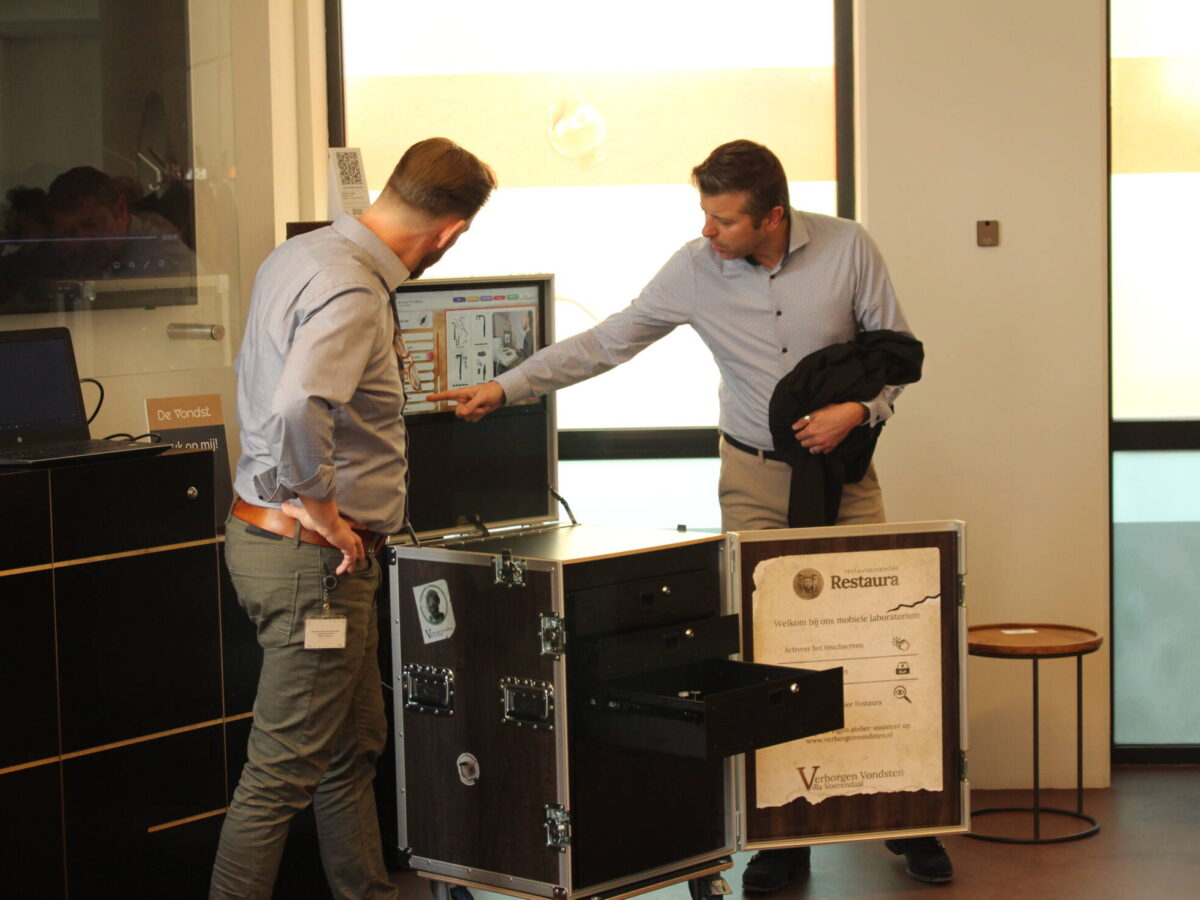
Soon they will be able to travel 2,000 years back in time with you: the volunteers of Restaura. Thanks to a robust travel case, they take you to the site of the Roman villa on the Steinweg in Voerendaal.
The chance that you can make this journey back in time is greatest for pupils in primary or secondary education. You can also meet the volunteers at events in Limburg. In total, 12 volunteers have been trained and 6 large cases, also known as flight cases, have been prepared.
The contents of the case show exactly the time journey you make: a modern laptop has been built in with a presentation that can be projected. On board are also copies of objects found at the site of the Roman villa in Voerendaal. Thanks to 3D photography and 3D printing, they are indistinguishable from the real thing. But the showpiece of each case is a real Roman find: for example, a piece of a 2,000-year-old roof tile.
Importance of heritage
The project launched on 11 April was set up by Restaura in Heerlen. This company conserves and restores archaeological finds. Restaura took care of the design and contents of the travel cases and of the training of the volunteers.
The idea “Going out with archaeology” came up when Restaura was asked: how can more people see the finds from Villa Voerendaal?
“There is also a higher goal behind it,” says Rasmus Thelen, member of the management of Restaura. “We chose to reach a young audience because we also want to show how important our heritage is. And this project shows what is needed to preserve heritage for future generations.”
That idealistic goal appealed: institutions such as the VSB Fund, Prins Bernhard Fund, Mondriaan Fund and the Province of Limburg support the project financially. Restaura was a logical partner because it is involved in the restoration of finds from Voerendaal and therefore has extensive knowledge available. It is expected that presentations will be given until the summer, possibly autumn 2024. The project starts in June 2023.
Under grain, potatoes or sugar beet
Under grain, potatoes or sugar beet, beneath the fields along the Steinweg in Voerendaal lie the remains of one of the largest Roman farms found to date in the Netherlands. Around the year 200, this was an enormous estate of 13 hectares with a central residential building with heated rooms, cellar, bathhouse, granary, forge, workshops and dwellings. A colonnade 150 metres long offered a covered walkway between the main building, bathhouse and granary. During excavations as many as 45,000 large and small archaeological finds were uncovered. These are now stored in a special provincial depot.