Roman Valley Bocholtz part of an archaeological park?
Author: Harry Lindelauf
Photography: Rijksmuseum van Oudheden
Roman Valley Bocholtz part of an archaeological park?
A working group will investigate whether an archaeological park is feasible at Vlengendaal, on the border between Bocholtz and Orsbach (Germany). The international set-up should be comparable to the German-Dutch business park Avantis. The chosen theme is the centuries-old history of the border in this area, including the Roman legacy in the form of four villae rusticae. Since the 19th century, remains of walls and floors, a cinerary chest, and a hoard of coins have been excavated from these Roman farmsteads.
The idea for the archaeological park stems from a meeting of Dutch and German archaeologists in Bocholtz. They discussed the findings of a study conducted by cultural entrepreneur Marc Hermans. Commissioned by the municipality of Simpelveld and the Province of Limburg, he examined whether it would be possible to reconstruct a Roman villa rustica in the Vlengendaal area. The conclusion of the study is brief and clear: no, it is not feasible. This is due in part to regulations protecting the Roman remains and the fact that the land is privately owned.
The border is visible in the landscape: in the elevated course of the centuries-old Aachen landwehr and in the remnants of the Westwall defensive structures from the Second World War. The next step in the planning process is the appointment of the members of the working group, which will have a German-Dutch composition.
Photo caption
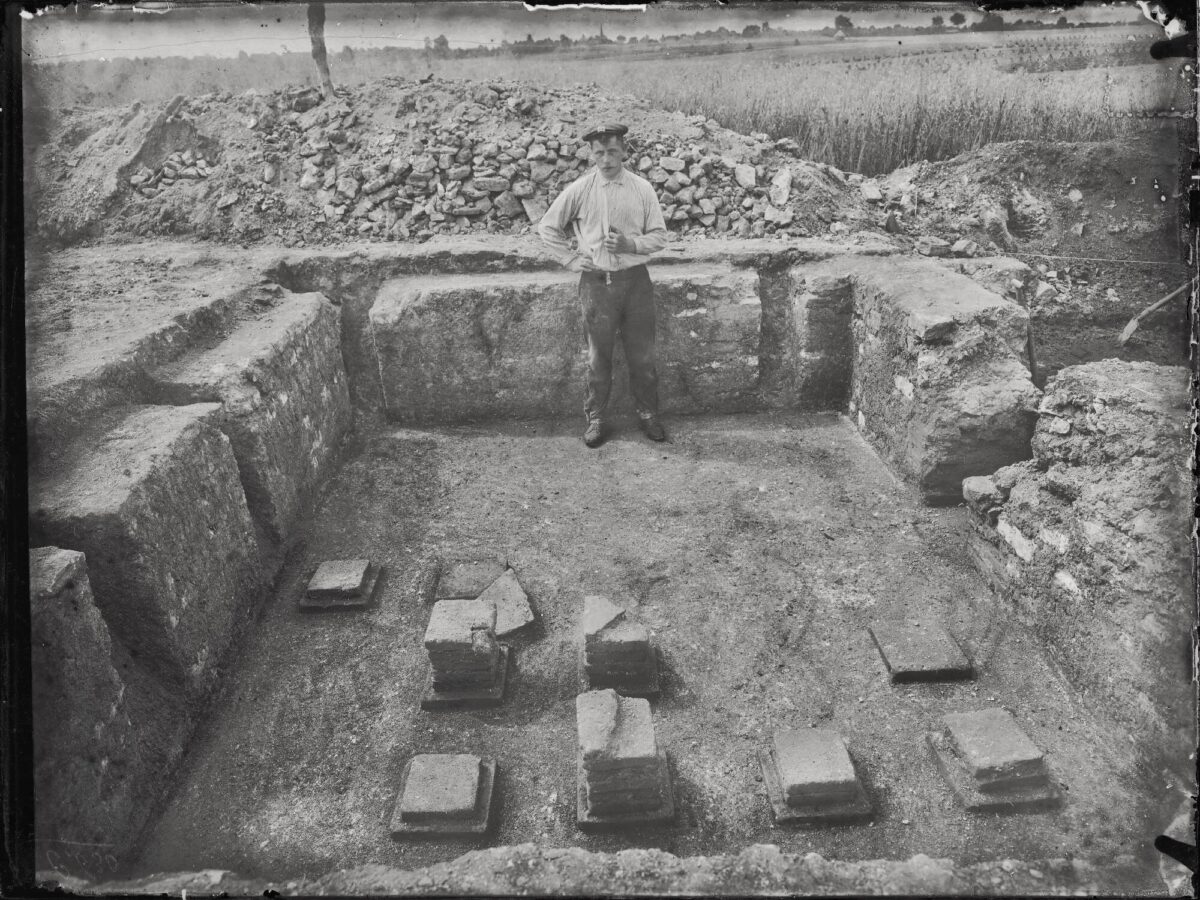
Photo of the 1913 excavation of the Roman villa at Vlengendaal. Part of the heating cellar is visible, with columns supporting the tiled floor. In the background stands A. Scholten, one of the assistants during the excavation.