Roman Bocholtz Exhibition – Display Case 1
Hoeve Overhuizen - Bocholtz
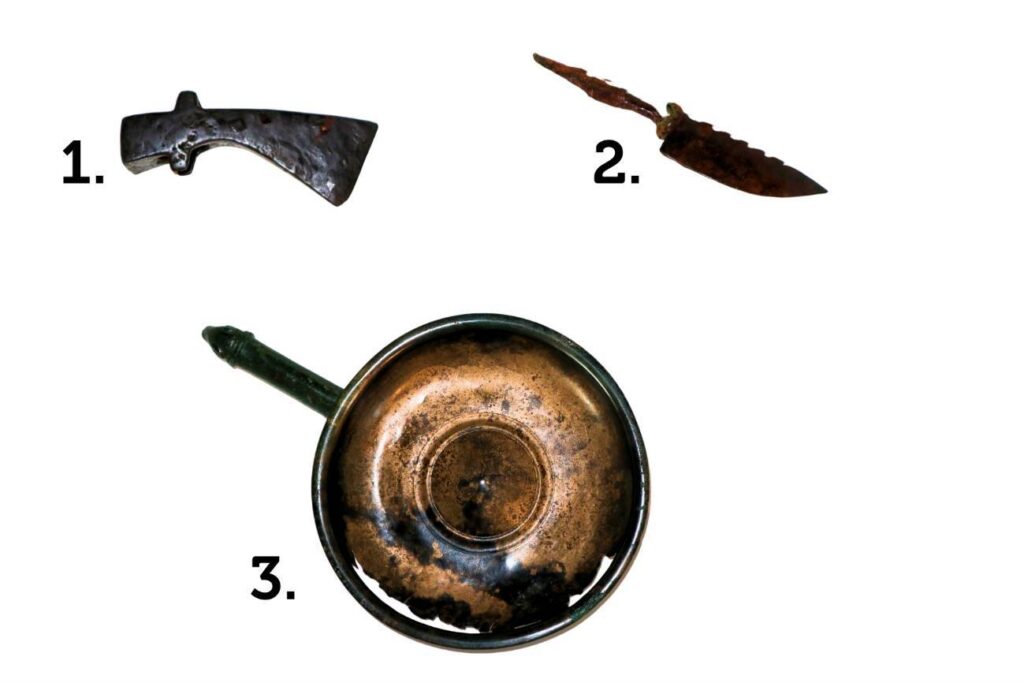
1. Axe Head
Mid-2nd century AD
Original, Provincial Archaeological Finds Repository Limburg
This pointed iron object is the head of an axe. The hole where the handle was fitted is clearly visible. This is a medium-sized axe, intended for gathering wood to make a fire. In the northern provinces of the Roman Empire, this type of axe was introduced by the army and has been found in both military and civilian contexts.
2. Dagger with Sheath
Mid-2nd century AD
Original, Provincial Archaeological Finds Repository Limburg
Among the many grave goods, an elaborately decorated dagger with a leather cover (sheath) was also discovered. The mass of soil and iron surrounding the find required extensive conservation. What could be seen immediately, however, was that the ensemble was richly decorated, with some sections even embellished with gold leaf.
3. Washing Bowl with Handle
Mid-2nd century AD
Original, Provincial Archaeological Finds Repository Limburg
This iron and bronze bowl was used together with a pouring jug for washing hands before or during a meal, or when making offerings. The bowl has a smooth handle ending in a ram’s head. This feature, combined with the type of bowl, makes this grave good relatively rare.
Iron folding chair / Sella castrensis
Mid-2nd century AD
Replica; the original is in too poor a condition to be displayed
This X-shaped iron frame, together with a seat—possibly made of leather or textile—formed a folding chair. Decorative finials project from the ends of the seat and adorn the pivot points. These finials are shaped like lions’ heads.
Because the chair could be folded, it was used by high-ranking army officers who frequently travelled from place to place. Graves containing folding chairs are thought to be the final resting places of veterans who became wealthy landowners after completing their military service.